In Hoboken, one of the wealthiest school districts in New Jersey, the chronic absenteeism rate for white students was 3.9% in 2023-24. For Black students in the same district, it was 31.3%. That 27.4 percentage-point gap is not an artifact of small sample sizes or data noise. It is the second-largest local expression of a pattern that runs across the entire state: COVID blew open New Jersey's attendance equity gap, and three years of recovery have not put it back together.
Statewide, the gap between Black and white chronic absenteeism rates stood at 9.6 percentage points before the pandemic. It nearly doubled to 17.5 points in the first year back. By 2024, it has narrowed to 10.0 points, close enough to pre-pandemic levels that a casual reading of state averages might declare the crisis resolved.
It is not resolved. The gap is still 0.4 points wider than 2019. And the Hispanic-white gap, which drew less attention during the emergency, has widened by 37%, from 5.1 to 7.0 percentage points, with no sign of closing.
Two kinds of recovery
The statewide chronic absenteeism rate fell from its 2022 peak of 18.1% to 14.9% in 2024, placing New Jersey second-lowest nationally behind Alabama. That aggregate improvement masks sharply unequal recoveries.
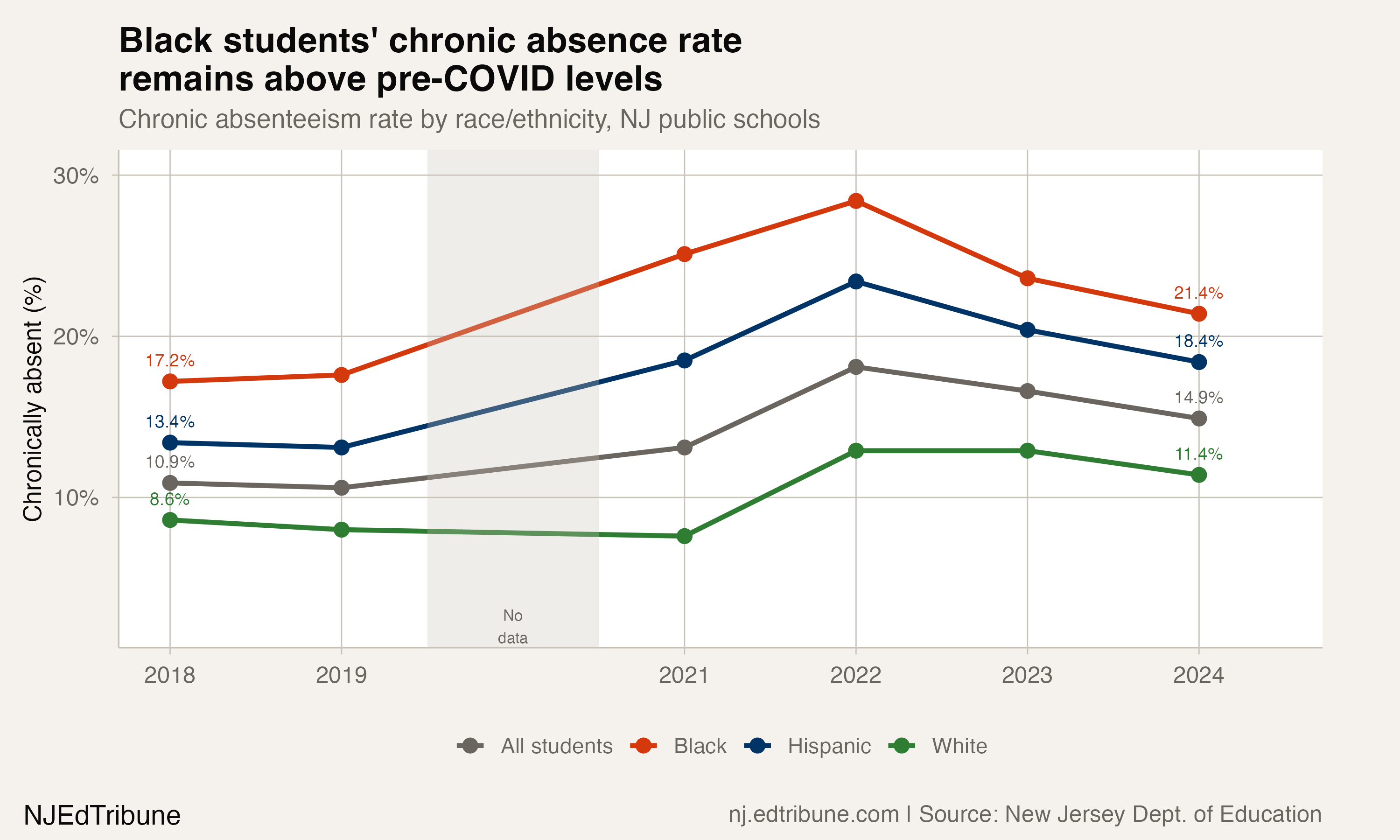
White students' chronic absenteeism rate was 8.0% in 2019. It spiked to 12.9% in 2022, then fell to 11.4% by 2024, still 3.4 points above the pre-pandemic baseline. Black students' rate was 17.6% in 2019. It surged to 28.4% in 2022, more than double the rate of increase. By 2024 it had fallen to 21.4%, still 3.8 points above baseline. Hispanic students remain the furthest from their pre-pandemic normal: 18.4% in 2024 versus 13.1% in 2019, a 5.3-point residual gap that exceeds every other racial group.
The counterintuitive finding is that Black students have actually recovered the largest share of their COVID spike. Between 2022 and 2024, Black students recovered 64.8% of their pandemic-era increase, compared to 48.5% for Hispanic students and just 30.6% for white students.
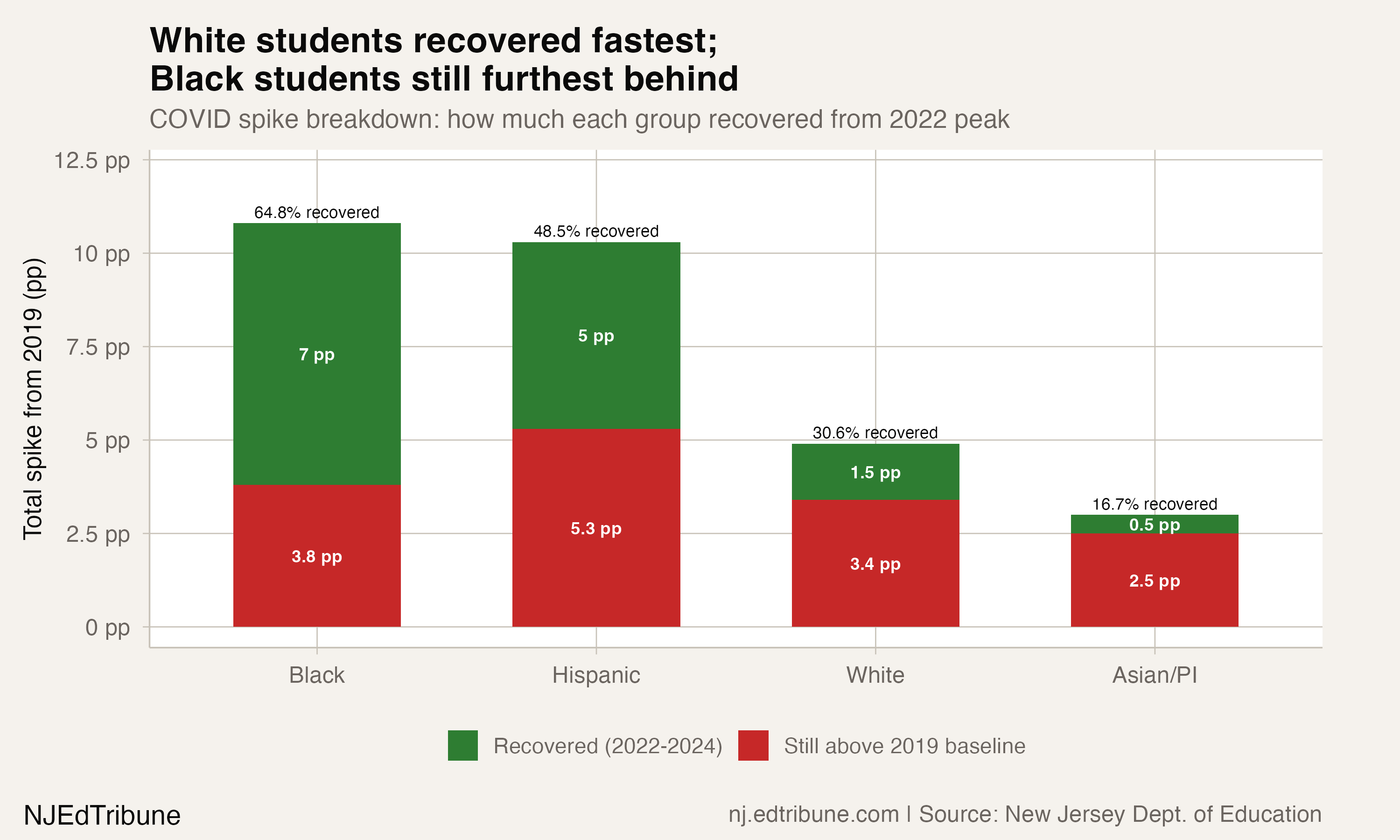
But recovering from a larger spike still leaves you further behind. A Black student who was chronically absent at 28.4% in 2022 and improved to 21.4% in 2024 is still missing more school than a white student who barely improved, from 12.9% to 11.4%. The arithmetic of proportional recovery does not translate to equitable outcomes.
The gap that widened more quietly
The Black-white gap commanded attention because it doubled so visibly. The Hispanic-white gap followed a similar trajectory but has proven more stubborn on the way down.
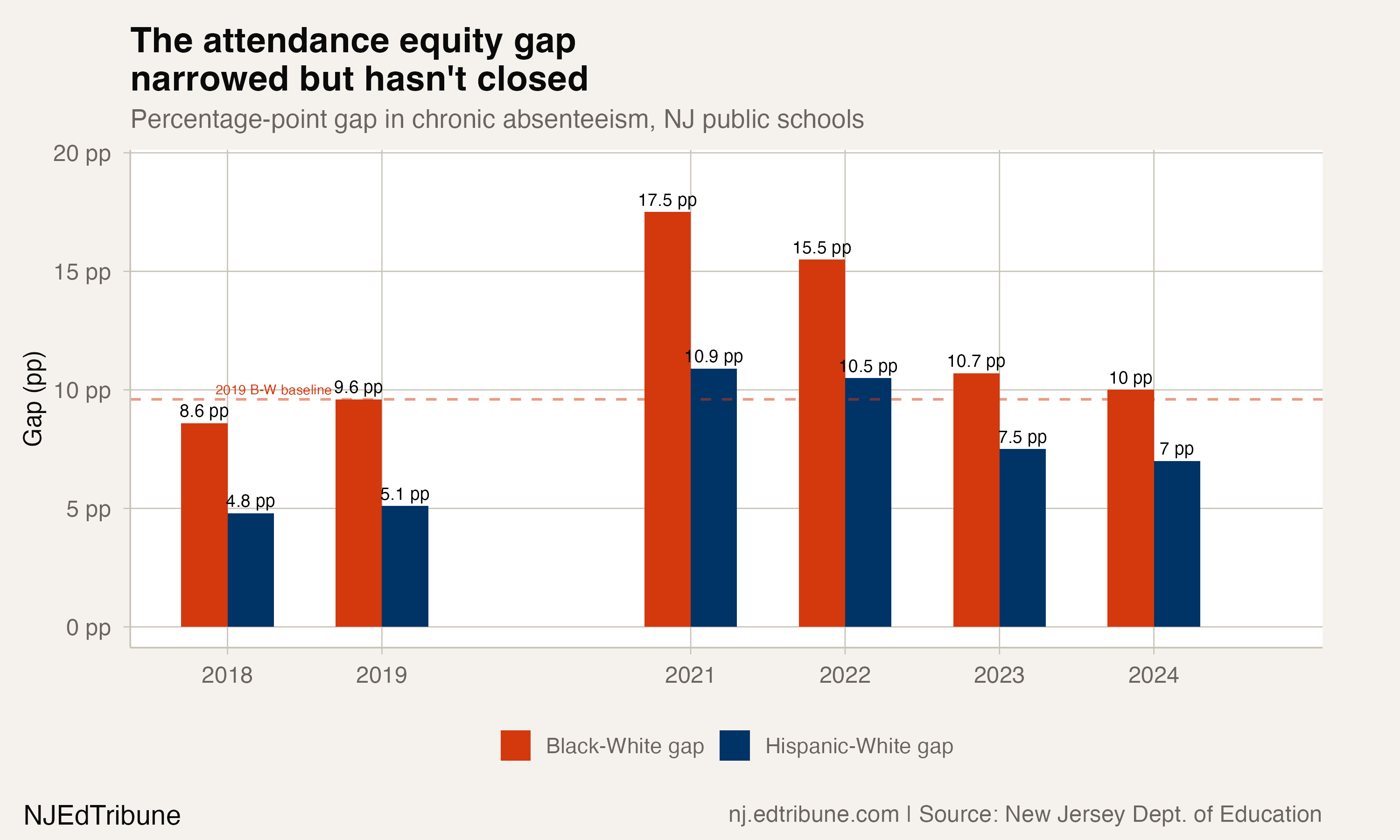
In 2019, the Hispanic-white gap was 5.1 percentage points. It surged to 10.9 points in 2021, then to 10.5 in 2022. By 2024, it had narrowed to 7.0 points, a 37% increase from the pre-pandemic baseline. The Black-white gap, by comparison, is 4% wider than 2019.
The divergence matters because Hispanic students are New Jersey's fastest-growing demographic. A persistent attendance gap in the state's largest student group compounds into widening achievement differences, course access gaps, and eventually graduation rate disparities.
Where the gaps are widest
The state average obscures enormous district-level variation. In 483 districts with both Black and white chronic absenteeism data, the median gap is just 2.5 percentage points. But 79 districts have gaps exceeding 10 points, and nine exceed 20 points.
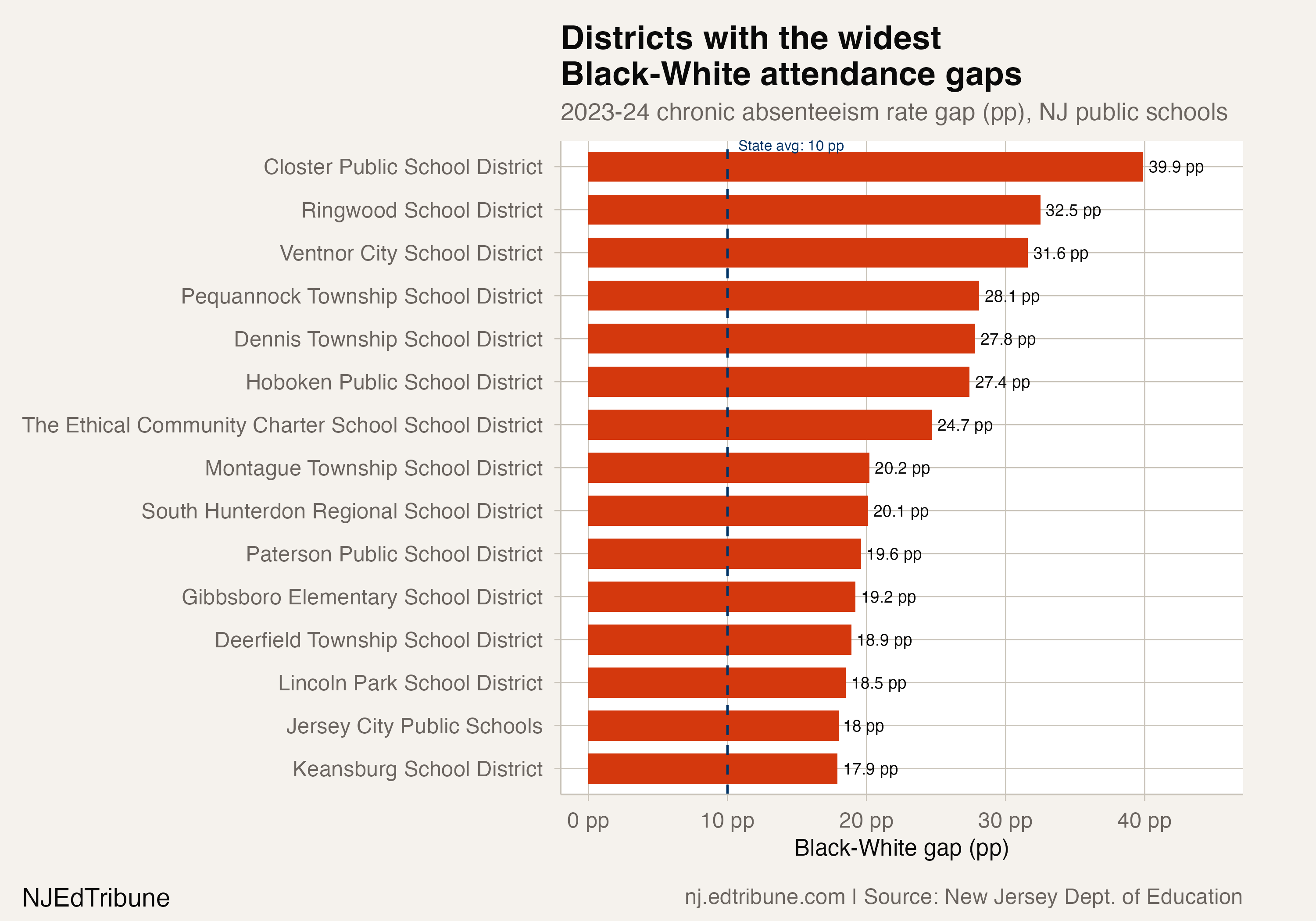
Closter, a Bergen County district where the median household income exceeds $150,000, has the state's widest gap at 39.9 points: 6.8% for white students, 46.7% for Black students. Ringwood (32.5 points), Ventnor City (31.6), and Pequannock Township (28.1) follow.
The pattern is not concentrated in high-poverty urban districts. Several of the widest gaps appear in suburban and exurban districts where Black enrollment is small in absolute terms, making each absence carry more statistical weight but also making the disparity harder to dismiss as a measurement artifact. These are districts where the institutional experience of attending school differs profoundly by race.
Paterson, with the state's second-largest enrollment, shows a 19.6-point gap (26.3% white, 45.9% Black). Jersey City's gap is 18.0 points (16.4% white, 34.4% Black).
Between 2019 and 2024, 210 districts saw their Black-white gap widen while 146 saw it narrow. The gap is not closing uniformly. It is widening in more places than it is shrinking.
Poverty, race, and overlapping disadvantage
The statewide rate for economically disadvantaged students (21.2% in 2024) closely tracks the Black student rate (21.4%), raising the question of whether the racial gap is really a poverty gap in disguise. The overlap between these categories is substantial: Black students are disproportionately represented among economically disadvantaged students in New Jersey.
But the gap cannot be fully explained by income. The economically disadvantaged rate closely tracked the Black rate throughout the pandemic, spiking to 28.0% versus 28.4% in 2022 and recovering in near-parallel. If the racial gap were entirely driven by poverty, white economically disadvantaged students would show similar rates to their Black peers at the same income level. State-level data does not allow that comparison directly, but the persistence of large gaps in affluent suburban districts like Hoboken (27.4 points) and Closter (39.9 points) suggests race-specific factors beyond household income.
A Rutgers State Policy Lab analysis published in December 2025 found that New Jersey's Black student chronic absenteeism rate of 21.4% exceeds Virginia's 19.2%, despite similar overall state performance. The report recommended that New Jersey "pursue cross-state collaboration, especially in service of reaching New Jersey's historically underserved student populations."
Legislative response
The state has responded with two pieces of legislation. Senate Bill 3776 established an 18-member Chronic Absenteeism Task Force charged with examining pandemic impacts and developing family engagement strategies. The task force must report within six months of organizing.
Separately, the current 2026-session proposal, Senate Bill 294, would require districts with chronic absenteeism rates at or above 10%, or with any school at or above 15%, to form Attendance Review Teams composed of administrators, counselors, social workers, and community representatives to develop intervention plans.
"Inconsistent attendance results in missed learning opportunities and contributes to students falling further behind." — State Senator Shirley K. Turner (D-15), S3776 sponsor
Newark offers one data point suggesting that concentrated, district-level effort can move the needle. The district reduced its chronic absenteeism rate from 12.1% to 10.4% in the 2024-25 school year, achieving three consecutive years of decline across all grade levels. Among large urban districts nationally, Newark now ranks first in lowest suspension-related absences across every reported demographic group. Whether that model translates to the suburban districts where gaps are widest is an open question.
Unequal rates of improvement
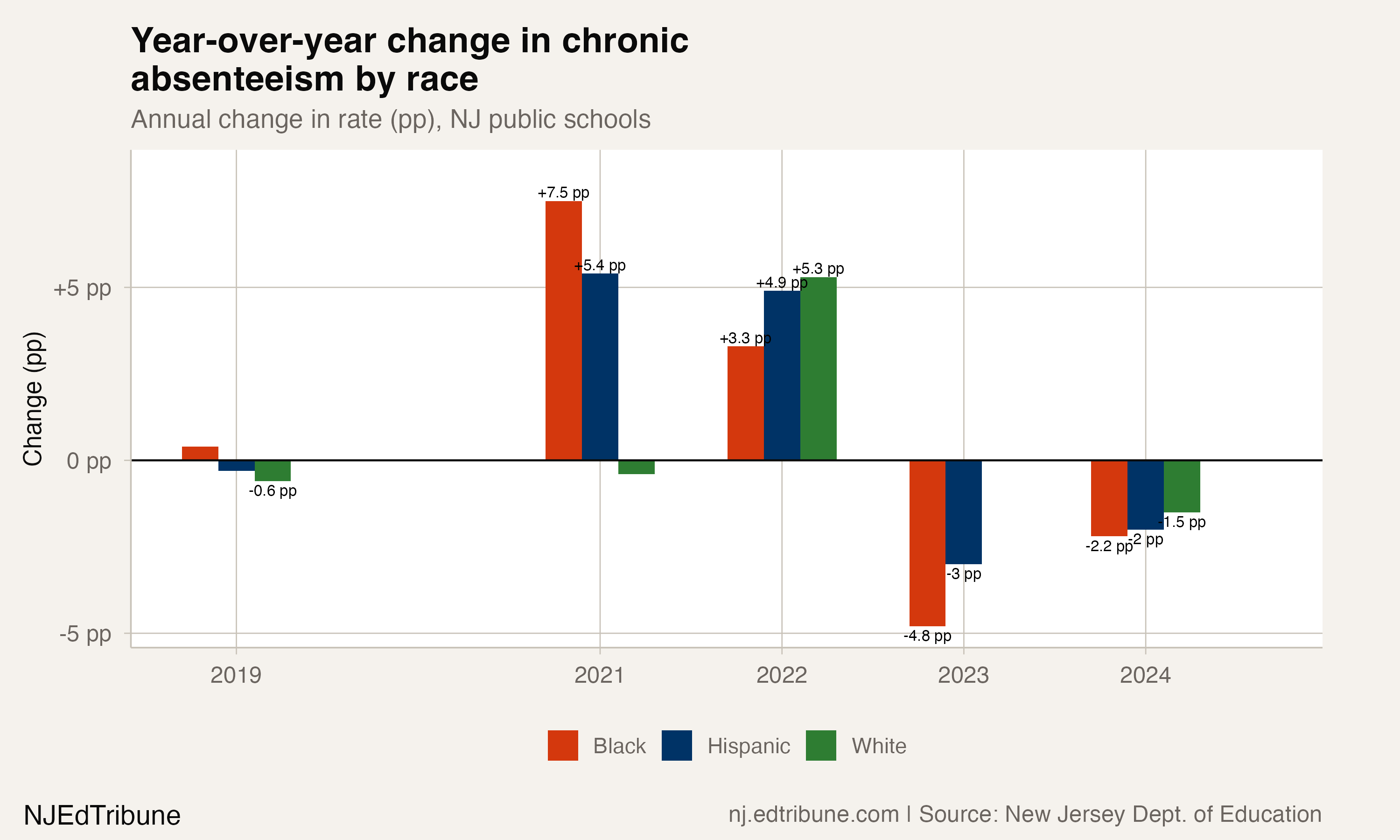
The year-over-year pattern reveals why the gap has been so slow to close. In 2021, Black students' chronic rate jumped 7.5 points in a single year while white students' rate actually fell 0.4 points. The following year, when chronic absenteeism surged broadly, Black students added another 3.3 points while white students jumped 5.3. Then came the recovery years: in 2023, Black students improved by 4.8 points, white students by zero. In 2024, both groups improved, Black by 2.2 points and white by 1.5.
The gap widened because Black students absorbed the COVID shock first and hardest. It has partially closed because Black students have been improving faster in the recovery years. But "faster" from a higher base does not equal "equitable." The gap narrowed from 15.5 points in 2022 to 10.0 in 2024, rapid progress driven by Black students' steep recovery. Yet progress stalled between 2023 and 2024, with the gap shrinking only 0.7 points. If that pace holds, it would take more than 14 years to close entirely.
At the current pace of closure -- 0.7 points per year -- the Black-white gap would not reach zero until 2038. And that assumes the pace holds. Between 2023 and 2024, progress decelerated. Meanwhile, in Hoboken, a district where the median household income exceeds $150,000, the gap between Black and white chronic absenteeism is 27.4 points. The gap is not a COVID artifact. COVID simply measured it at higher resolution.
Detailed code that reproduces the analysis and figures in this article is available exclusively to EdTribune subscribers.
Discussion
Sign in to join the discussion.
Loading comments...