In Westfield, 2.3% of students were chronically absent last school year. Thirty miles south in Camden, the figure was 46.9%. Both numbers appear in the same state report, filed under the same metric, subject to the same 10% threshold that is supposed to trigger corrective action.
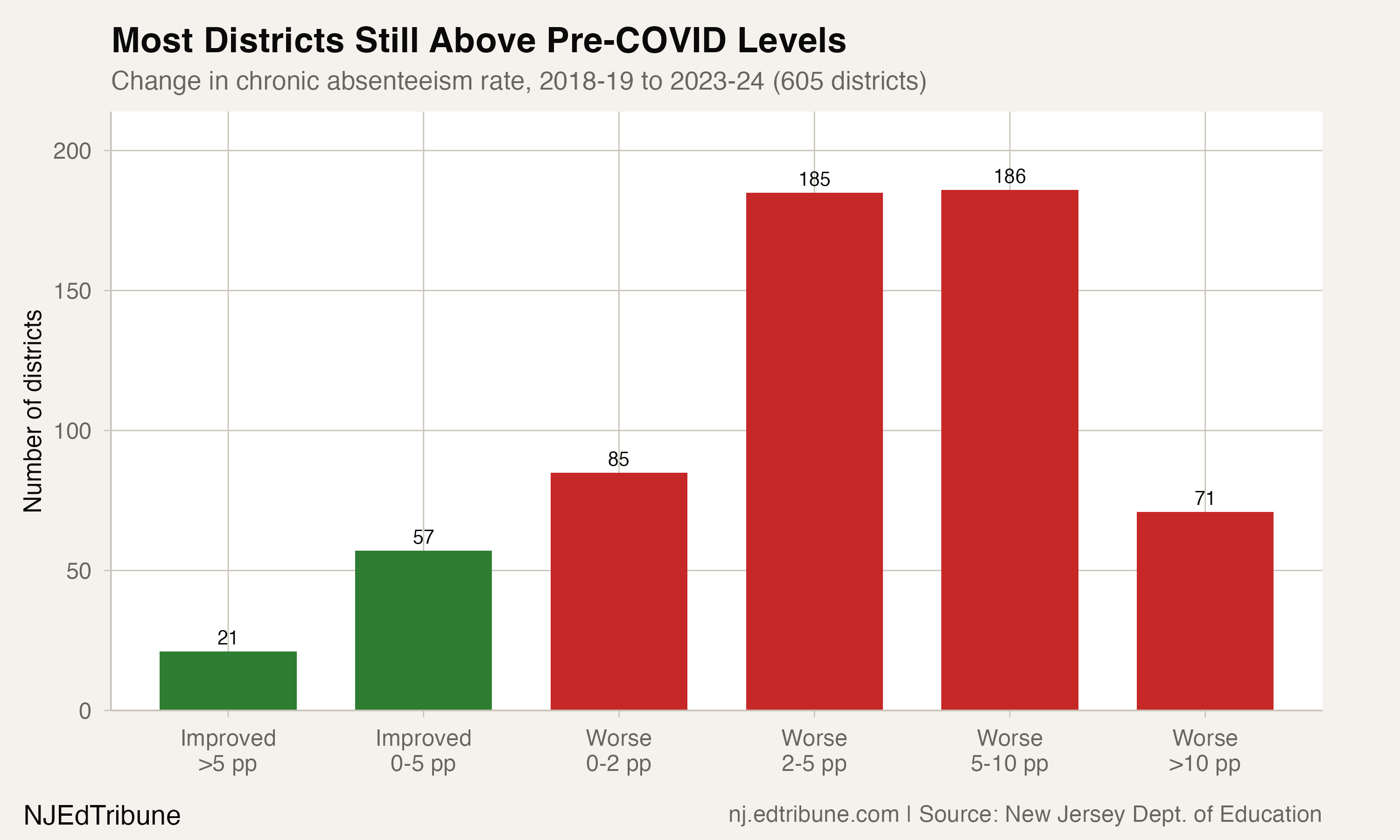
New Jersey's statewide chronic absenteeism rate fell to 14.9% in 2023-24, down from its pandemic peak of 18.1% two years earlier. That improvement is real, and it earned the state the second-lowest chronic absenteeism rate in the country, behind only Alabama. But the state-level number conceals a harder truth: of the 605 districts with pre-COVID comparison data, only 78 have returned to their 2018-19 attendance levels. That is 12.9%, roughly one in eight.
The other seven in eight are still operating in a world the pandemic made.
The distance from normal
Before COVID, 10.6% of New Jersey's 1.4 million public school students were chronically absent, defined as missing 10% or more of the school year. That baseline held steady for at least two years. Then it jumped to 13.1% in 2020-21, spiked to 18.1% in 2021-22, and has been falling since: 16.6% in 2022-23, 14.9% in 2023-24.
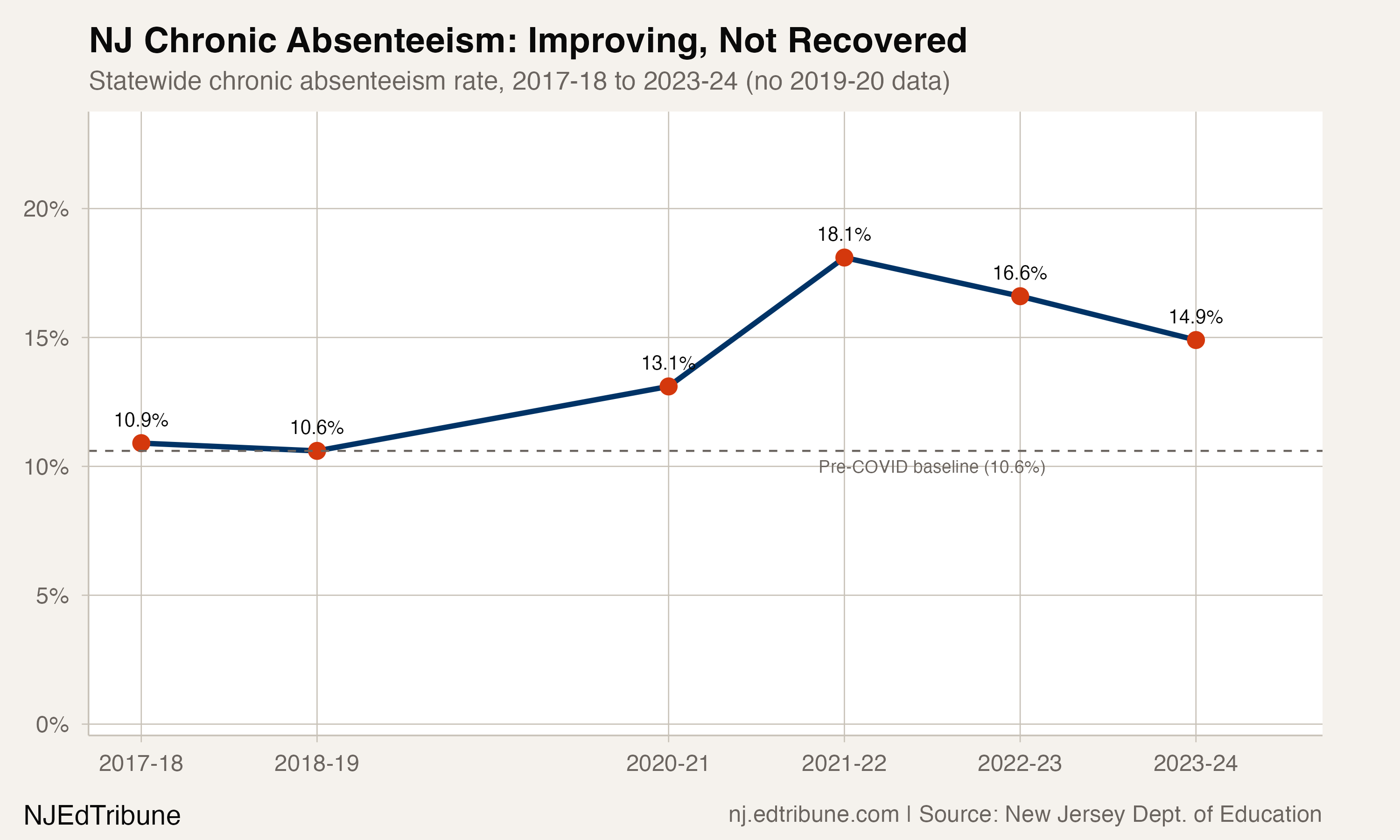
The trajectory looks encouraging in isolation. The state recovered 3.2 percentage points from its peak in two years, clawing back 1.5 points in the first year and 1.7 in the second. But it remains 4.3 points above the pre-COVID floor. At this pace, reaching the old baseline would take another two to three years, assuming the trend continues, which is far from certain.
Among individual districts, the recovery is not just slow. For most, it has not happened. The median non-recovered district sits 4.9 percentage points above its pre-COVID rate. More than 60% of districts are at least two points worse off. Seventy-one districts are more than 10 points above their pre-pandemic levels. Ninety-one districts, 14.0% of all districts reporting data, posted their worst chronic absenteeism rate on record in 2023-24.
Camden, Paterson, Trenton: the anchor cities
The state's worst chronic absenteeism concentrates in a handful of urban districts where rates were already elevated before the pandemic and then accelerated.
Camden City School District, which has been under state operation since 2013, recorded a 46.9% chronic absenteeism rate in 2023-24. That is 13.1 points higher than its pre-COVID rate of 33.8%. Nearly half the district's students missed at least 18 days of school. Paterson reached 35.7%, up from 27.6%. Trenton hit 34.0%, up from 30.0%.
At KIPP Cooper Norcross, a Renaissance school in Camden, chronic absenteeism reached 45.5% in 2023-24, more than double its pre-pandemic rate of 21.1%. The Philadelphia Inquirer reported that Camden Prep, another city Renaissance school, saw 50.2% of its students chronically absent, up from 30.0% before the pandemic. Andrew Bell, the superintendent in neighboring Woodbury, told the Inquirer: "There are so many nuances of why kids aren't in school."
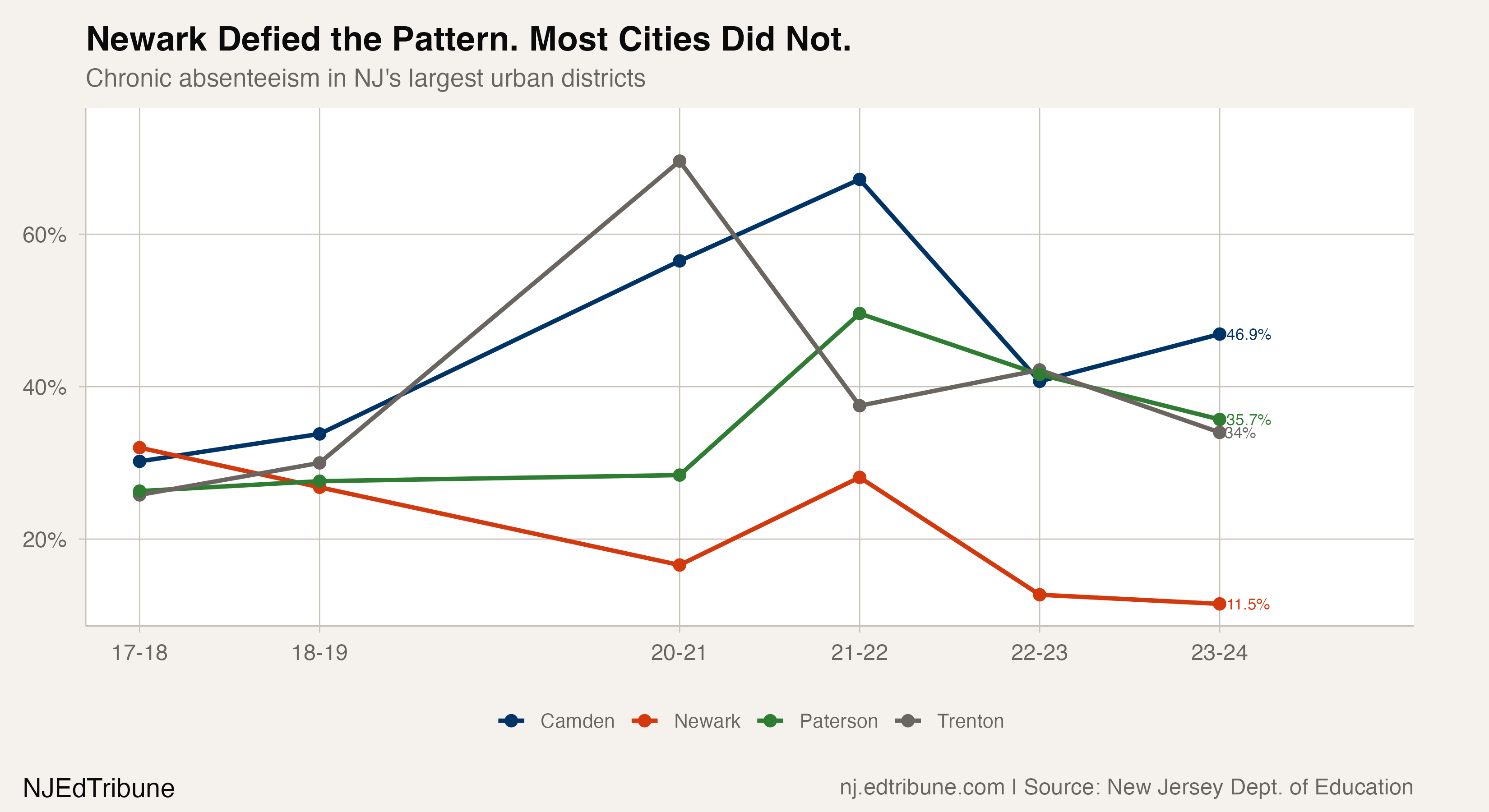
Then there is Newark, which defied the pattern entirely.
The Newark exception
Newark Public School District, the state's largest, dropped from a 26.8% chronic absenteeism rate in 2018-19 to 11.5% in 2023-24, a 15.3 percentage point improvement. No other major district in the state came close. The district's chronic rate is now below the statewide average.
The improvement continued in 2024-25. Newark reported that its overall chronic absenteeism rate dropped further to 10.4% in 2024-25, with an average attendance rate of 95.1%. Superintendent Leon credited "the hard work of our families, staff, and community partners." The district's Office of Attendance, Truancy Task Force, and attendance counselors are cited as driving the improvement.
What makes Newark's trajectory unusual is not just the magnitude but the consistency. Its chronic rate fell in three of the four post-pandemic years, while Camden and Paterson fluctuated wildly. Newark's 2024 rate of 11.5% is less than half its 2019 rate. The data does not suggest any structural or reporting changes that would explain this, though the state performance reports do not fully document methodology shifts at the district level. The improvement appears genuine.
The question is whether Newark's approach can be replicated. State Board member Nedd Johnson told Chalkbeat that "the house is on fire here when you have that percentage of students missing 18 days or more," referring to the statewide picture. Newark may have put out its fire. Most districts have not.
Every subgroup is worse off
The pandemic's attendance damage was not distributed evenly, and neither is the recovery. Every major student group in New Jersey has a higher chronic absenteeism rate in 2023-24 than in 2018-19.
Hispanic students saw the largest increase: 5.3 percentage points, from 13.1% to 18.4%. Economically disadvantaged students rose 5.2 points to 21.2%. English learners climbed 5.0 points to 17.2%. Students receiving special education services increased 4.5 points to 21.0%.
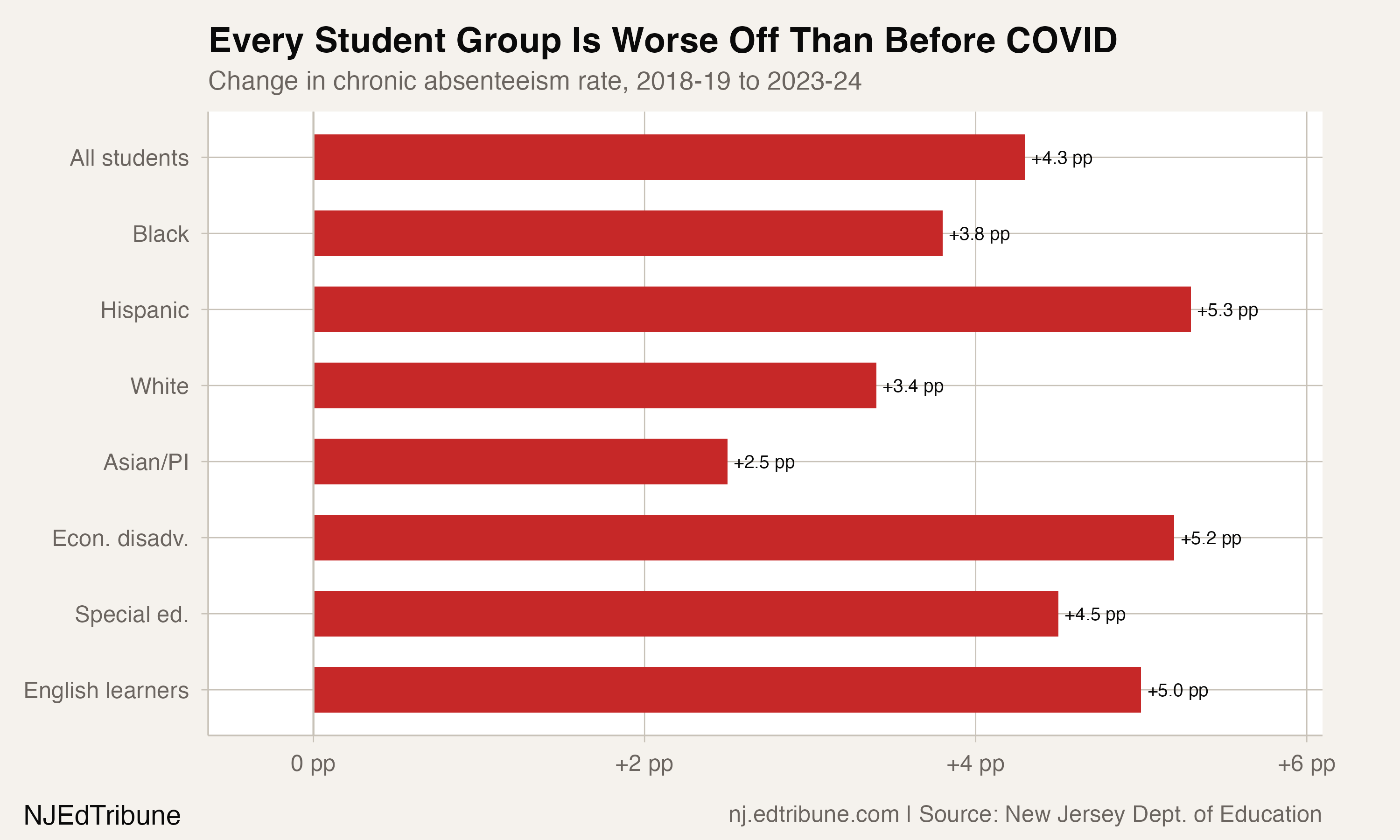
Black students had the highest absolute chronic absenteeism rate at 21.4%, though their increase since pre-COVID (3.8 points) was smaller than Hispanic or economically disadvantaged students. The Black-white gap in chronic absenteeism was 9.6 points before the pandemic, spiked to 17.5 points in 2020-21, and has narrowed back to 10.0 points. It remains wider than it was in 2018-19.
Students experiencing homelessness face a different order of magnitude: 40.9% were chronically absent in 2023-24. Students in foster care reached 27.4%.
Asian and Pacific Islander students had both the lowest rate (7.3%) and the smallest increase (2.5 points) since pre-COVID.
The charter sector gap
Charter schools entered the pandemic with chronic absenteeism rates roughly comparable to traditional districts: a median of 8.7% versus 7.4% in 2018-19. The pandemic blew that gap open. By 2021-22, the charter median hit 18.1% while traditional districts reached 13.2%. Two years of recovery have narrowed the difference, but charters still sit at a median of 14.6% compared to 11.5% for traditional districts.
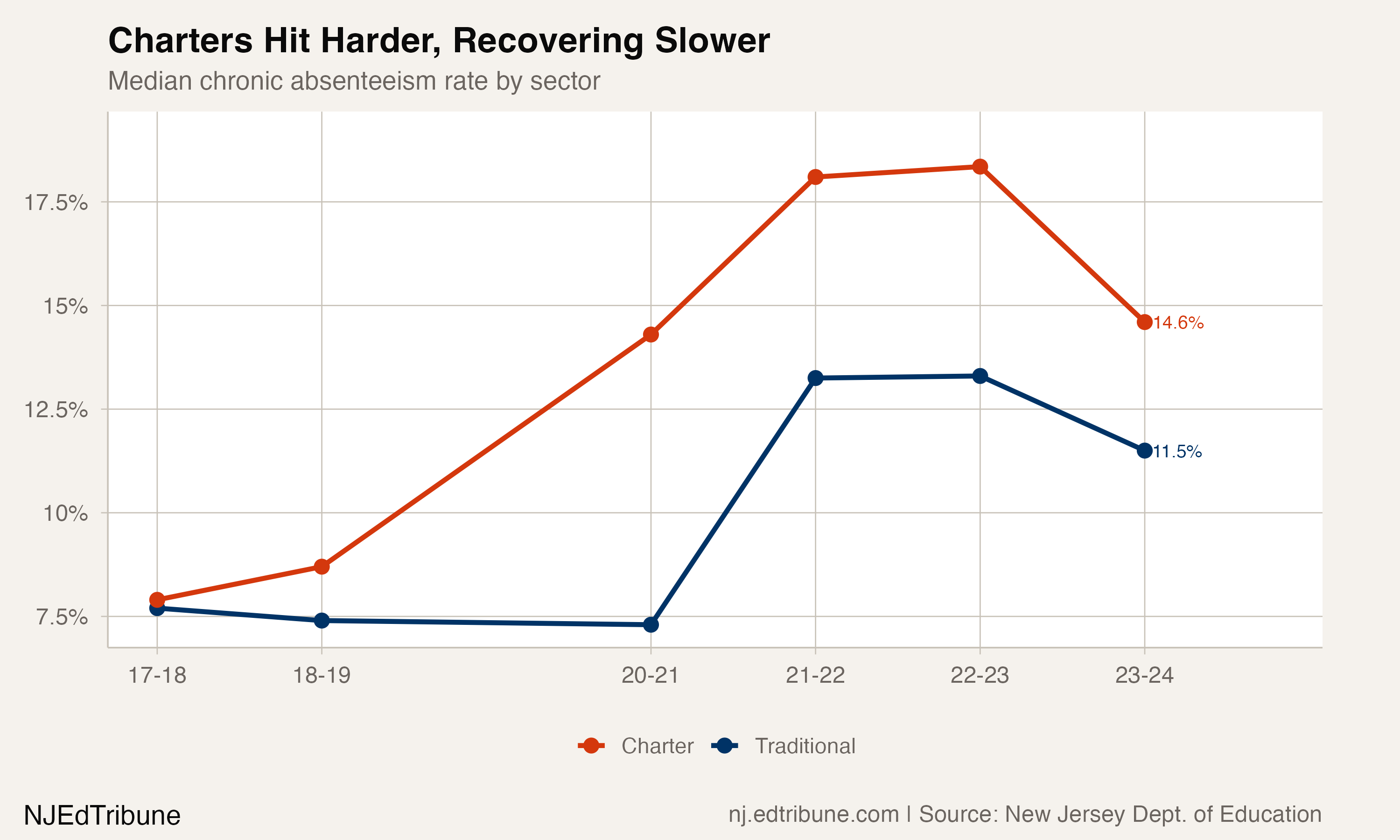
The recovery rates tell a similar story. Among districts with pre-COVID comparison data, 12.4% of traditional districts have recovered versus 16.7% of charters. The charter sector's slightly higher recovery rate is misleading: charters fell further and have more ground to make up. Their median rate is still 3.1 points above traditional districts.
The pattern is likely driven partly by where charters operate. New Jersey's charter schools concentrate in the same urban districts, Camden, Newark, Paterson, where chronic absenteeism is most severe. A charter school in Camden faces many of the same attendance barriers as the traditional district, regardless of governance model.
What the state is doing about it
New Jersey requires every district with a chronic absenteeism rate above 10% to establish an Attendance Review Team and develop a corrective action plan. Before the pandemic, about 32% of schools exceeded that threshold. By 2022-23, more than 70% did.
In December, Governor Murphy signed S3776, establishing an 18-member Chronic Absenteeism Task Force charged with examining root causes and recommending interventions. The task force includes educators, community members, and researchers, and must report findings within one year. Chalkbeat reported that Nelida Valentin of the Princeton Area Community Foundation called for "a coordinated state approach" to "help strengthen and connect what is happening on the ground."
Separately, the state's NJ4S program, a student mental health support network launched in 2023, reached 281,972 students with Tier 1 services by mid-2025, an 18% increase over its first year. The program addresses one of the four root cause categories the state has identified: school aversion driven by anxiety and mental health challenges.
Whether these efforts are sufficient depends on what the data is actually measuring. If most of the post-pandemic increase reflects a genuine behavioral shift, where families now view occasional absences as more acceptable, policy interventions face a cultural headwind. If it reflects specific, addressable barriers such as transportation, health access, or safety concerns, then targeted programs can move the needle. The data cannot distinguish between these explanations. The task force is designed to try.
The 73.5% and the 24.8%
There is one encouraging signal buried in the district-level data. In 2023-24, 73.5% of districts improved their chronic absenteeism rate year-over-year, compared to 51.0% the year before. The direction of travel, for most districts, is correct.
But 24.8% of districts got worse between 2022-23 and 2023-24, even as the state rate fell. And improvement is not the same as recovery. A district that moved from 25% to 22% chronic absenteeism improved. It is still more than double its pre-COVID rate. The state's 2nd-place national ranking is real, but it reflects a nationwide collapse in attendance norms, not a return to pre-pandemic health.
The Rutgers State Policy Lab noted that New Jersey could learn from Alabama's targeted approach despite Alabama having a far higher share of economically disadvantaged students, 64.7% versus New Jersey's 38.1%. Relative performance against peer states is useful. It does not change the fact that 527 New Jersey school districts are operating with higher chronic absenteeism than they had before the pandemic, and 91 are at their worst levels ever recorded.
The task force has one year to produce recommendations. The 605 districts have students right now.
Detailed code that reproduces the analysis and figures in this article is available exclusively to EdTribune subscribers.
Discussion
Sign in to join the discussion.
Loading comments...