In Ocean Gate, a barrier island borough in Ocean County with a single school and fewer than 300 students, chronic absenteeism hit 43% in 2023-24. Before the pandemic, it was 7%. The statewide rate has been falling for two consecutive years, and New Jersey ranks second-lowest nationally. Ocean Gate has gotten worse every single year since 2021.
That is the paradox at the center of New Jersey's attendance recovery. The state number moves in the right direction. The district numbers tell a different story.
The statewide picture
New Jersey's chronic absenteeism rate peaked at 18.1% in 2021-22, the worst in the state's reporting history. Two years of improvement brought it to 14.9% by 2023-24, a 3.2 percentage point drop. The state now ranks second-lowest nationally, trailing only Alabama at 14.8%.
That framing flatters the recovery. The pre-COVID rate was 10.6%. New Jersey has clawed back 3.2 of 7.5 percentage points, or 42.7% of the gap. At the current pace of 1.6 points per year, the state would not return to its pre-pandemic baseline until 2027.
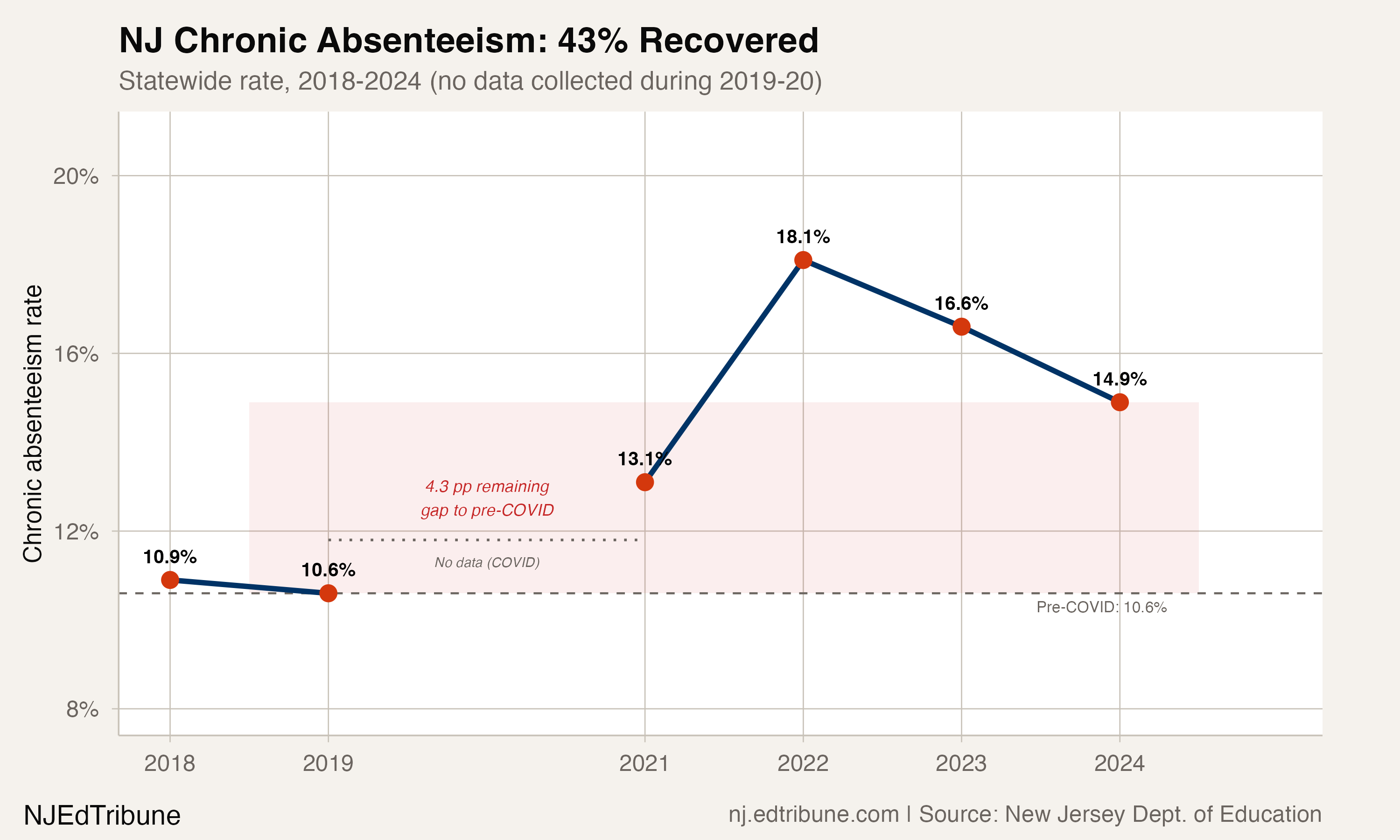
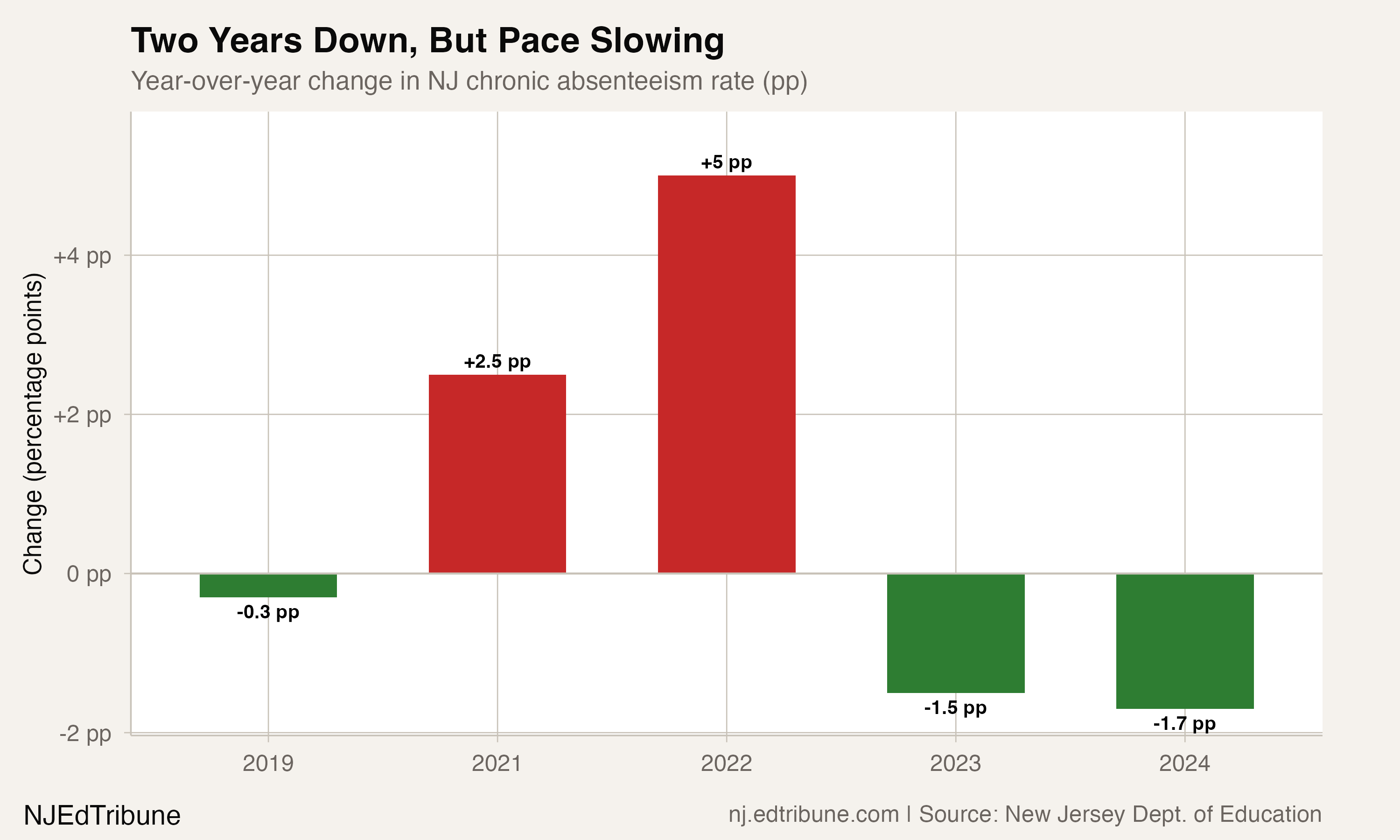
The year-over-year improvements have been modest: 1.5 points in 2022-23, 1.7 points in 2023-24. The initial surge was far steeper. Chronic absenteeism climbed 2.5 points in the first year back from COVID (2020-21), then accelerated to a 5.0-point jump in 2021-22. Two years of recovery have not yet undone one year of deterioration.
172 districts are worse now than at the pandemic peak
The state average obscures a distribution that would unsettle any education official.
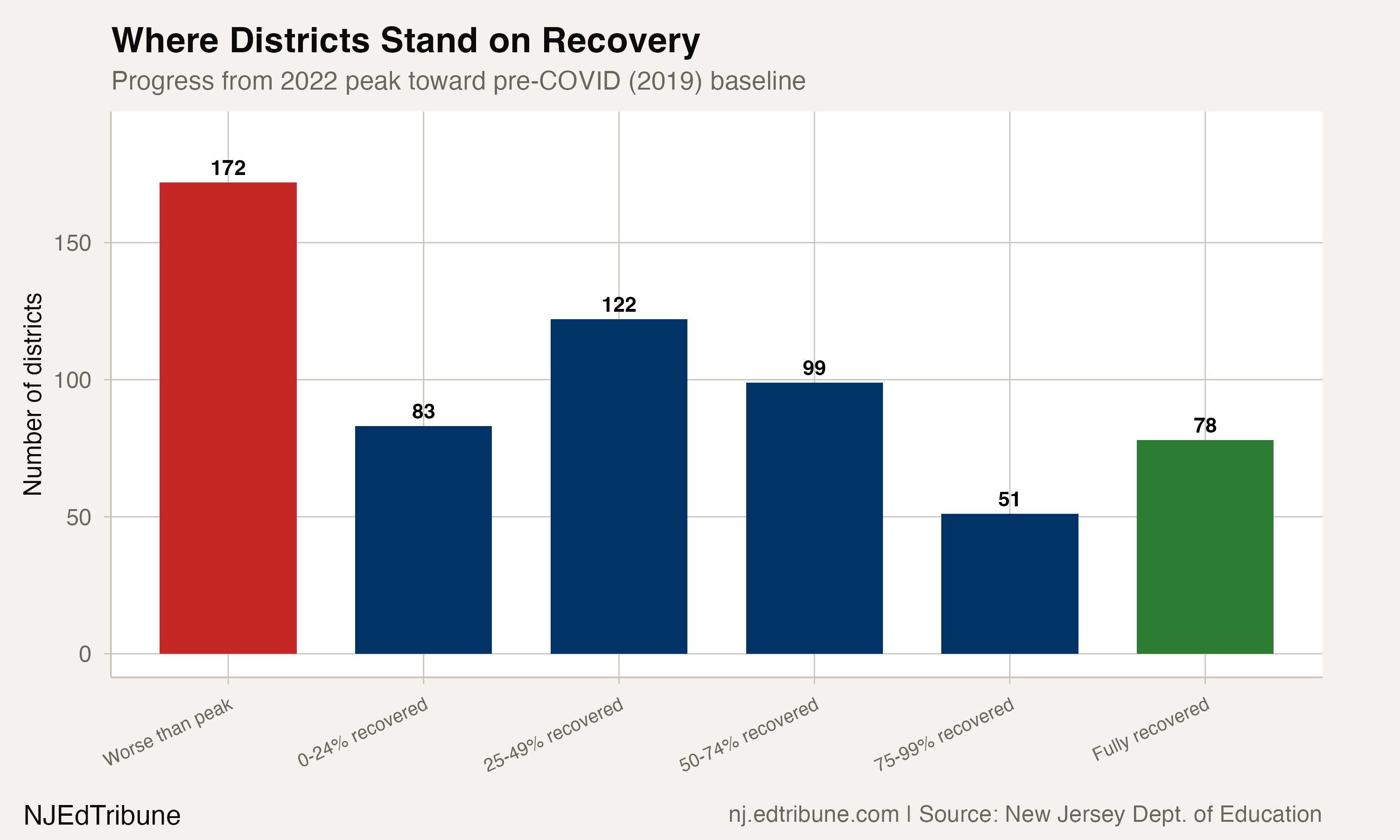
Of 605 districts with comparable data across 2019, 2022, and 2024, only 78 (12.9%) have fully recovered to their pre-COVID chronic absenteeism rates. At the other end, 172 districts (28.4%) posted a higher chronic rate in 2023-24 than they did at the statewide peak in 2021-22. The median district has recovered just 32.4% of its pandemic-era increase.
The 47 districts on four-year worsening streaks, getting worse every year since 2021, span the state's geography and demography. They include Keansburg (33.8%, up from 24.3% pre-COVID) on the Raritan Bay shore, Haledon (24.6%) in Passaic County, and Lacey Township (20.7%) in Ocean County. Some are tiny. Livingston, a well-resourced Essex County suburb, is on the list at 4.2%, a rate that would be enviable in Camden but represents a steady annual climb since 2021.
The urban divergence
The largest cities tell four different stories.
Newark, the state's largest district, has pulled off something close to unprecedented. Its chronic rate fell from 26.8% in 2018-19 to 11.5% in 2023-24, a 15.3 percentage point improvement that brought it well below the statewide average and its own pre-COVID baseline. In 2024-25, the district reported the rate dropped further to 10.4%, with elementary chronic absenteeism at 8.8%.
"These results reflect the hard work of our families, staff, and community partners to keep students engaged, supported, and present." -- Newark Superintendent Roger León, Newark Public Schools, 2025
Camden City moved in the opposite direction. After an initial recovery from 67.2% (2021-22) to 40.7% (2022-23), the rate reversed, climbing back to 46.9% in 2023-24. Nearly half of all Camden students are chronically absent. KIPP Cooper Norcross, a Renaissance school operating in the city, saw its rate jump from 21.1% pre-COVID to 45.5%, the largest increase among districts with 500 or more students. Camden Prep, operated by Uncommon Schools, hit 50.2%.
Paterson (35.7%) and Trenton (34.0%) have improved from their peaks but remain roughly where they were before the pandemic, or worse. Paterson's pre-COVID rate was 27.6%. Trenton's was 30.0%.
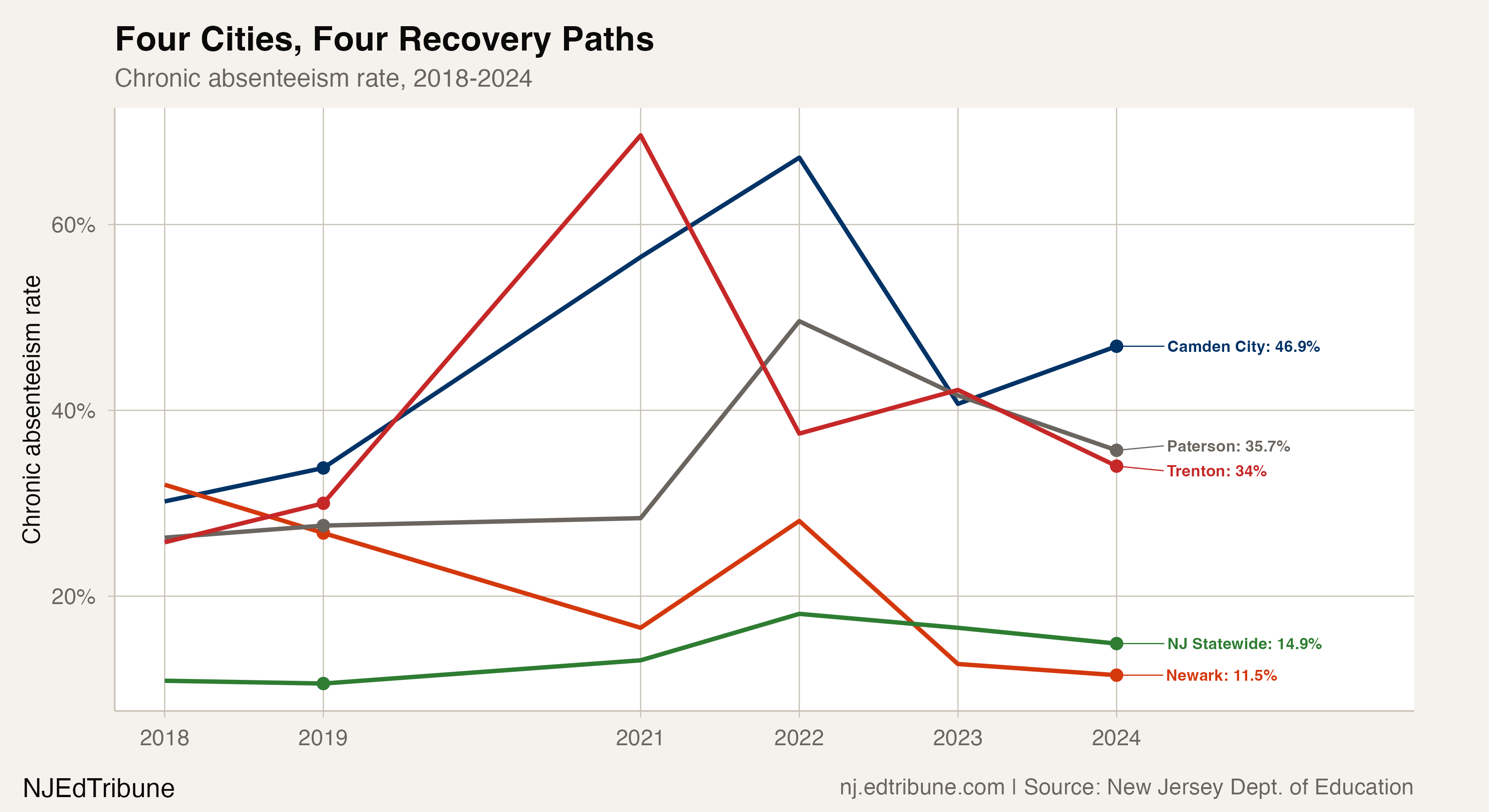
The gap between Newark and the other three cities is not new, but COVID widened it. In 2018-19, Newark's rate was comparable to Paterson's and lower than Camden's. By 2023-24, Newark's rate was less than a third of Camden's.
Where the gap is widest
The districts furthest from recovery are not all urban. Ocean Gate (a shore community), Seaside Heights (a boardwalk town), and Weymouth Township (rural Atlantic County) all saw chronic rates climb by more than 20 percentage points since 2019. Several charter schools appear on the list: Hope Community Charter School (up 26.2 points to 36.3%), Principle Academy Charter School (up 21 points to 27.7%), and Link Community Charter School (up 18.2 points to 21.5%).
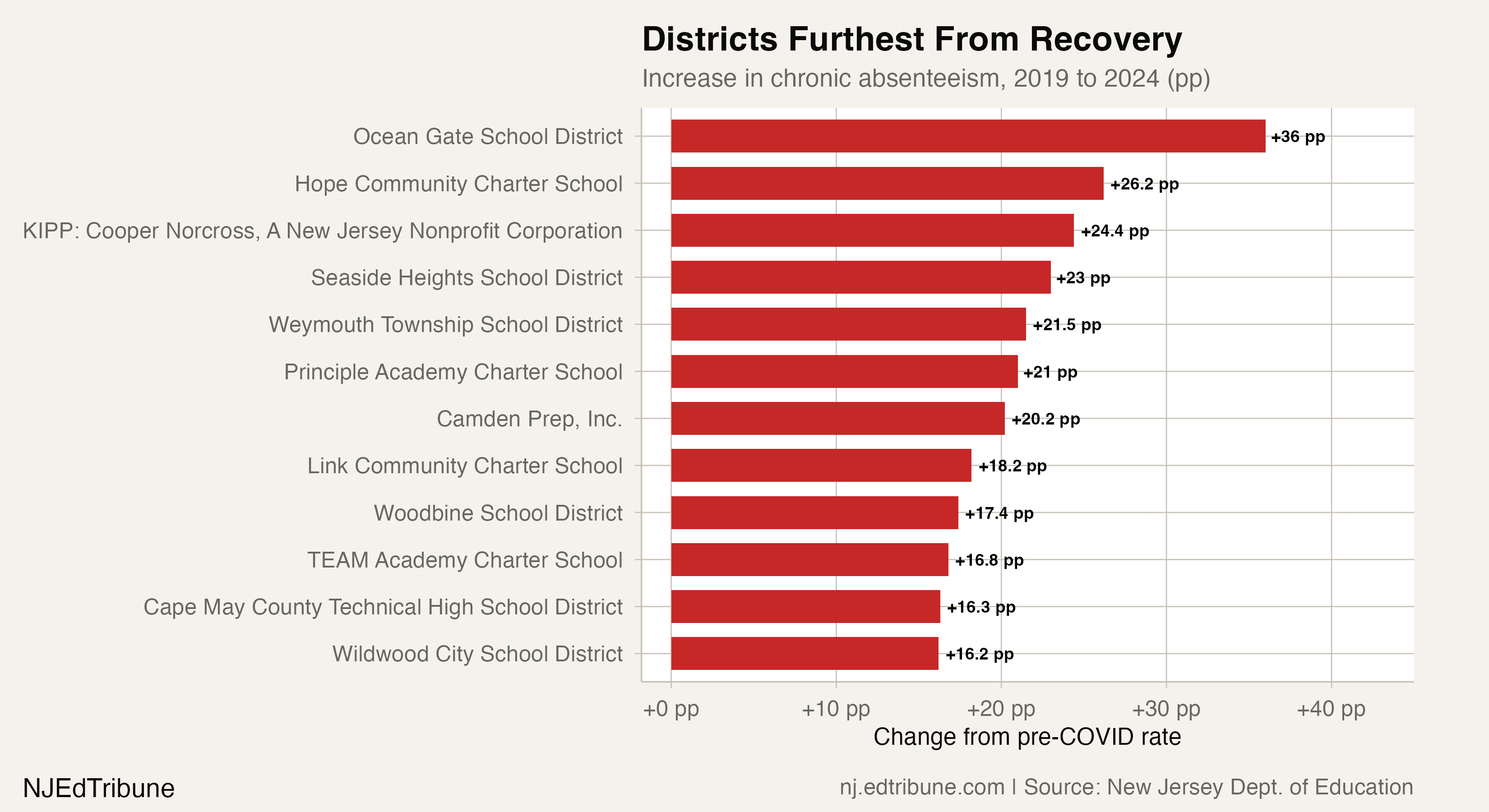
Charter districts averaged a 16.7% chronic rate in 2023-24, compared to 12.8% for traditional districts. That gap has persisted since before the pandemic but widened during it. In 2018-19, the median charter rate (8.7%) was close to the median traditional rate (7.4%). By 2023-24, median charter rates (14.6%) had pulled substantially ahead of traditional districts (11.5%).
What the state is doing about it
Governor Tahesha Way signed legislation in January 2026 creating an 18-member Chronic Absenteeism Task Force. The group, sponsored by Senators Shirley K. Turner and Angela V. McKnight, has one year to deliver findings and legislative recommendations. Its mandate includes root-cause analysis, a review of discipline policies, and an assessment of COVID's lasting effects on student engagement.
"Attendance is an indicator of whether students feel connected to their schools and supported in their learning environments." -- Senator Angela V. McKnight (D-Hudson), Hudson Reporter, 2026
New Jersey's funding structure matters here. Unlike California, Texas, and many other states, New Jersey funds schools based on enrollment, not average daily attendance. Districts do not lose per-pupil revenue when students miss school. The fiscal incentive to chase attendance is indirect, flowing through academic outcomes and intervention costs rather than direct budget impact. That structural difference makes New Jersey's attendance challenges qualitatively different from states where every absent student reduces revenue.
The state already requires districts with chronic rates above 10% to establish Attendance Review Teams, a threshold that 367 of 649 districts (56.5%) now exceed. The NJ4S school mental health program served 281,972 people with Tier 1 services in 2024-25, an 18% year-over-year increase. The state also hired 69 new school-based mental health professionals through the School-Based Mental Health Services Program.
The Newark question
The one data point that complicates any statewide narrative is Newark. A district with 37,000 students, concentrated poverty, and a majority-Black and Hispanic student body cut its chronic absenteeism rate by more than half in five years. Its chronic rate is now lower than the statewide average. Newark's Truancy Task Force, attendance counselors, and court-referral system are well-documented. The question the data cannot answer is whether Newark's approach is replicable, or whether its success reflects conditions (stable district leadership, community partner infrastructure, specific state interventions from its years under state control) that do not transfer easily.
What the data can say: Newark is the only major urban district in the state that achieved pre-COVID attendance levels. It did so while Camden, Paterson, and Trenton all remained at least 4 percentage points above their pre-COVID baselines.
The Task Force has a year. The data suggests the easy gains, the districts where recovery was mostly a matter of returning to normalcy, have already been captured. The 172 districts still above their pandemic peak, and the 47 getting worse every year, represent a harder problem. Those are the places where chronic absenteeism has settled into something structural, not a temporary disruption waiting to resolve itself.
Detailed code that reproduces the analysis and figures in this article is available exclusively to EdTribune subscribers.
Discussion
Sign in to join the discussion.
Loading comments...