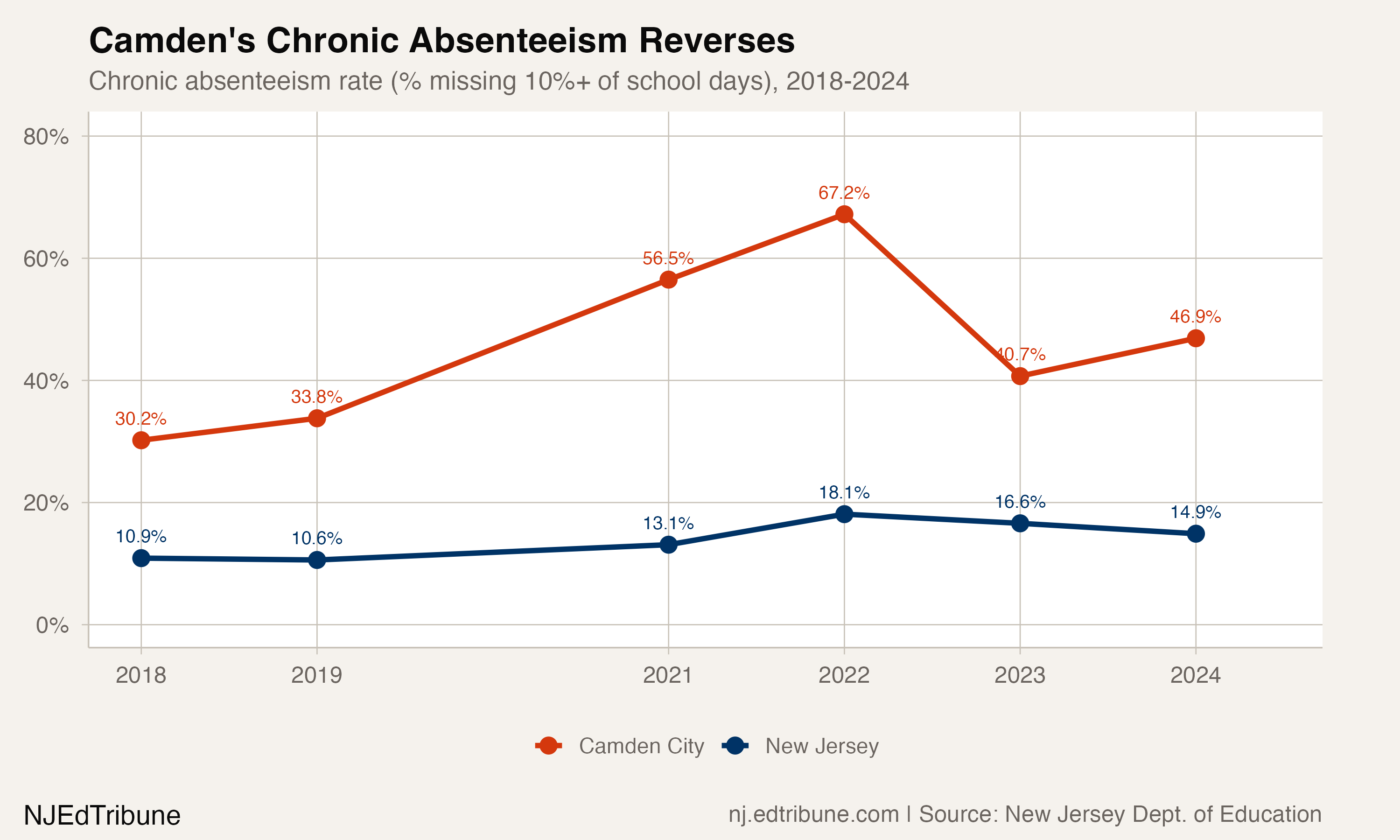
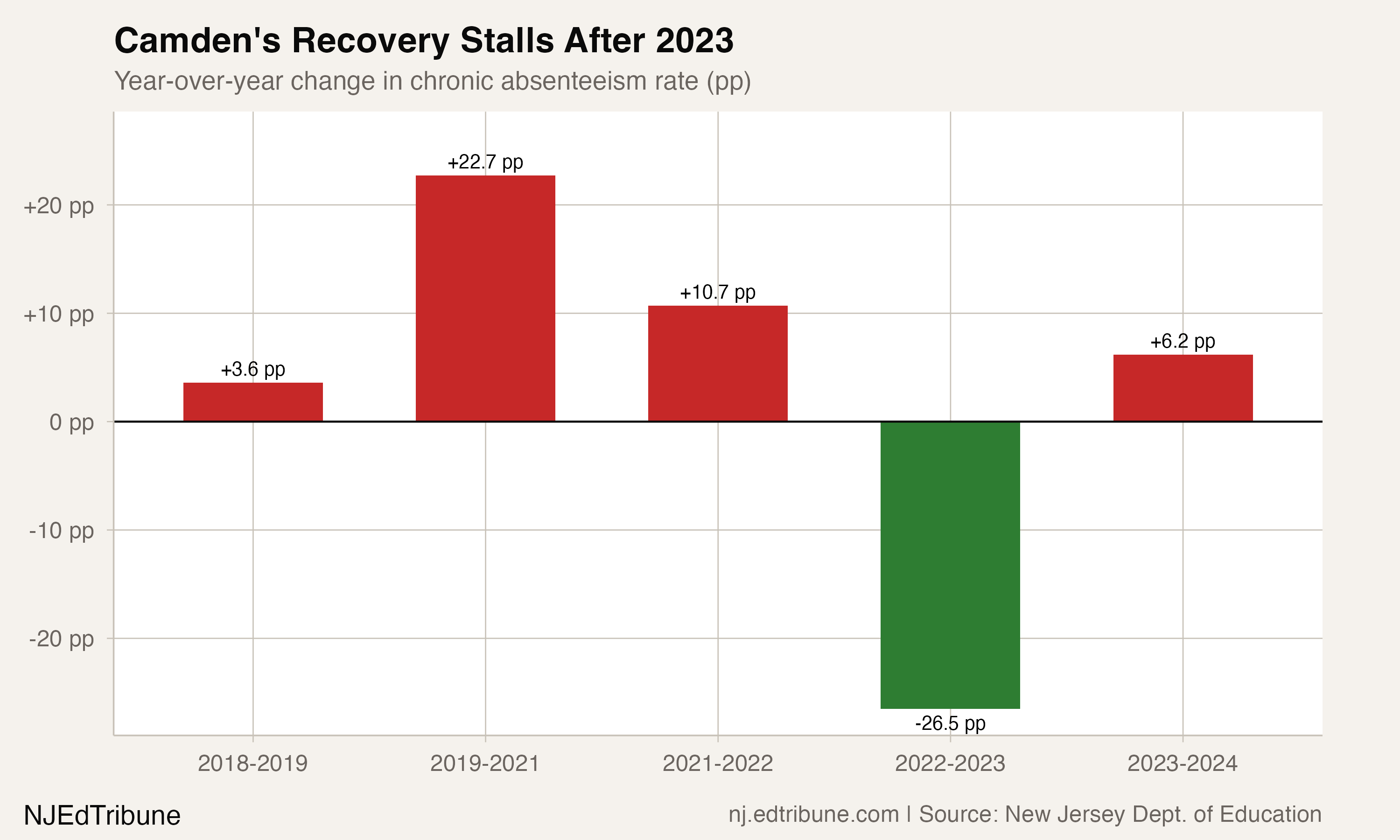
In 2022-23, Camden City School District cut its chronic absenteeism rate by 26.5 percentage points in a single year. At Camden High School, at H.B. Wilson Family School, at Morgan Village Middle, attendance officers went door to door. Students recited daily pledges. The superintendent set a 90% daily attendance target. And it worked: the rate fell from 67.2% to 40.7%.
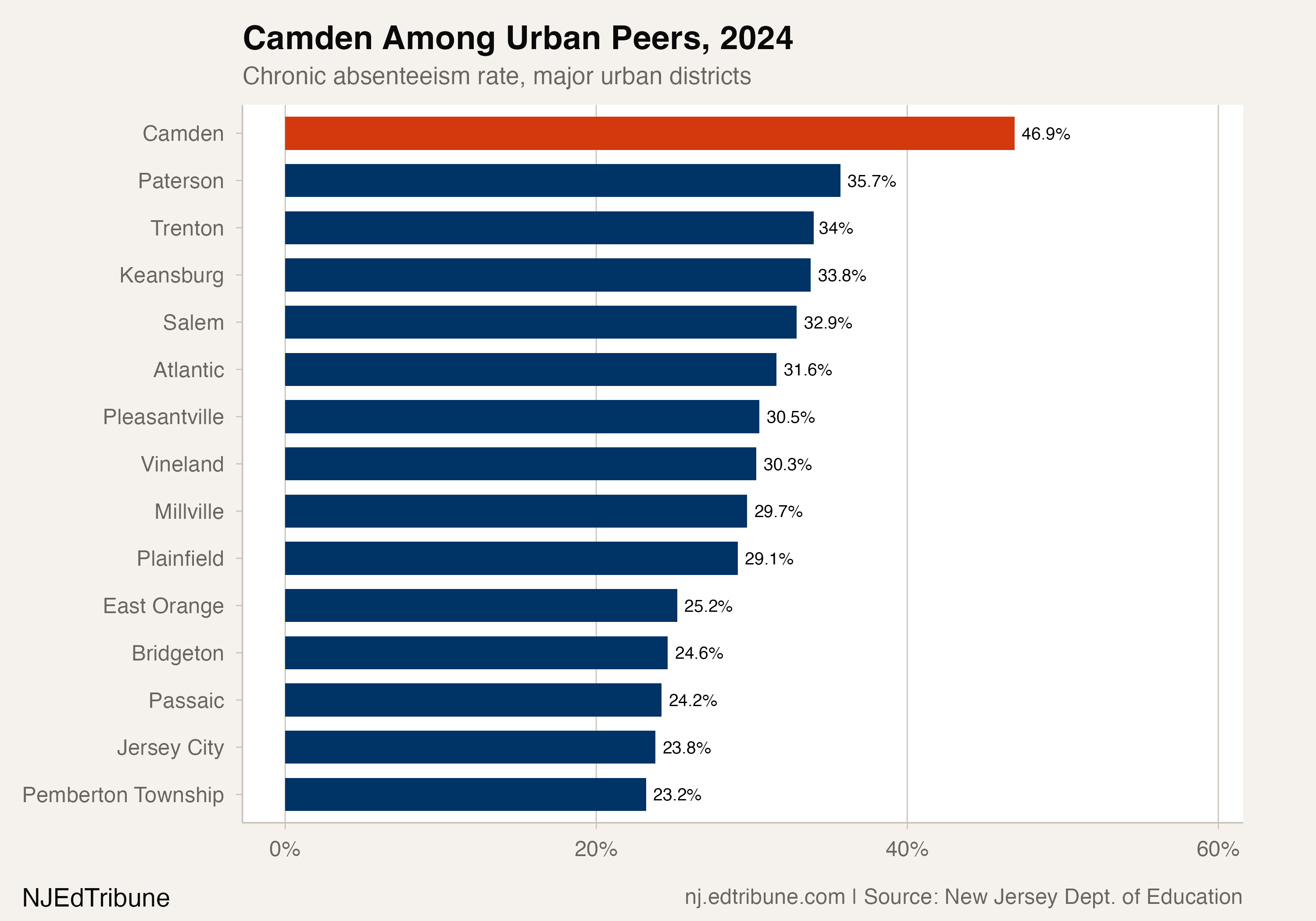
Then the 2023-24 numbers landed. Camden's rate climbed back to 46.9%, erasing nearly a quarter of the previous year's gains. The district still sits 13.1 percentage points above its pre-pandemic level, and 32 points above the state average. Among New Jersey's 650 districts, only two have a higher chronic absenteeism rate.
Seven out of 10 at Camden High
The reversal did not hit every school equally. At Camden High School, 69.9% of students were chronically absent in 2023-24, the highest rate of any traditional public school in the district. At Eastside High School, the rate was 60.7%. At Camden Big Picture Learning Academy, 58.8%.
Even the elementary schools that showed the strongest recovery in 2022-23 posted increases. The district-wide median school rate was 46.3%. Not a single one of Camden's 15 traditional schools fell below the statewide average of 14.9%. The closest were Creative Arts High School (26.4%) and Octavius V. Catto Community Family School (31.7%), still more than double the state rate.
The pattern before COVID was already severe: Camden's rate rose from 30.2% in 2017-18 to 33.8% in 2018-19 while the state held steady near 10.6%. The pandemic tripled the gap. By 2021-22, two out of three Camden students were chronically absent. The 2022-23 recovery was real but incomplete, and the 2023-24 reversal suggests the district's structural attendance problem runs deeper than pandemic disruption alone.
The gap that won't close
Camden's chronic absenteeism rate is 3.1 times the statewide average of 14.9%. That ratio has been remarkably stable: it was 2.8 in 2017-18, peaked at 4.3 in 2020-21 when the pandemic hit Camden disproportionately, and settled at 3.1 in 2023-24. No amount of recovery has brought the multiplier below its pre-pandemic level.
Among former Abbott districts, a group of 31 urban districts that receive supplemental state funding under New Jersey's school finance formula, Camden's rate is the highest by 11.2 percentage points. Paterson (35.7%) and Trenton (34.0%) are the nearest peers. Newark, which has received national attention for its own turnaround efforts, posted 11.5%, below the state average.
The gap is not just a Camden problem. Statewide, 94 of the 327 districts that improved in 2022-23 reversed course and posted higher rates in 2023-24, a 28.7% reversal rate. But Camden's reversal was larger in magnitude (6.2 percentage points) and started from a higher base than nearly any peer.
An equity picture that confounds expectations
Camden's subgroup data defies the conventional pattern where white students have the lowest chronic absenteeism and Black students have the highest. In Camden, white students (50.9%) and Black students (51.1%) have virtually identical rates, both above the district average of 46.9%. Hispanic students (43.9%) are the lowest-rate racial group.
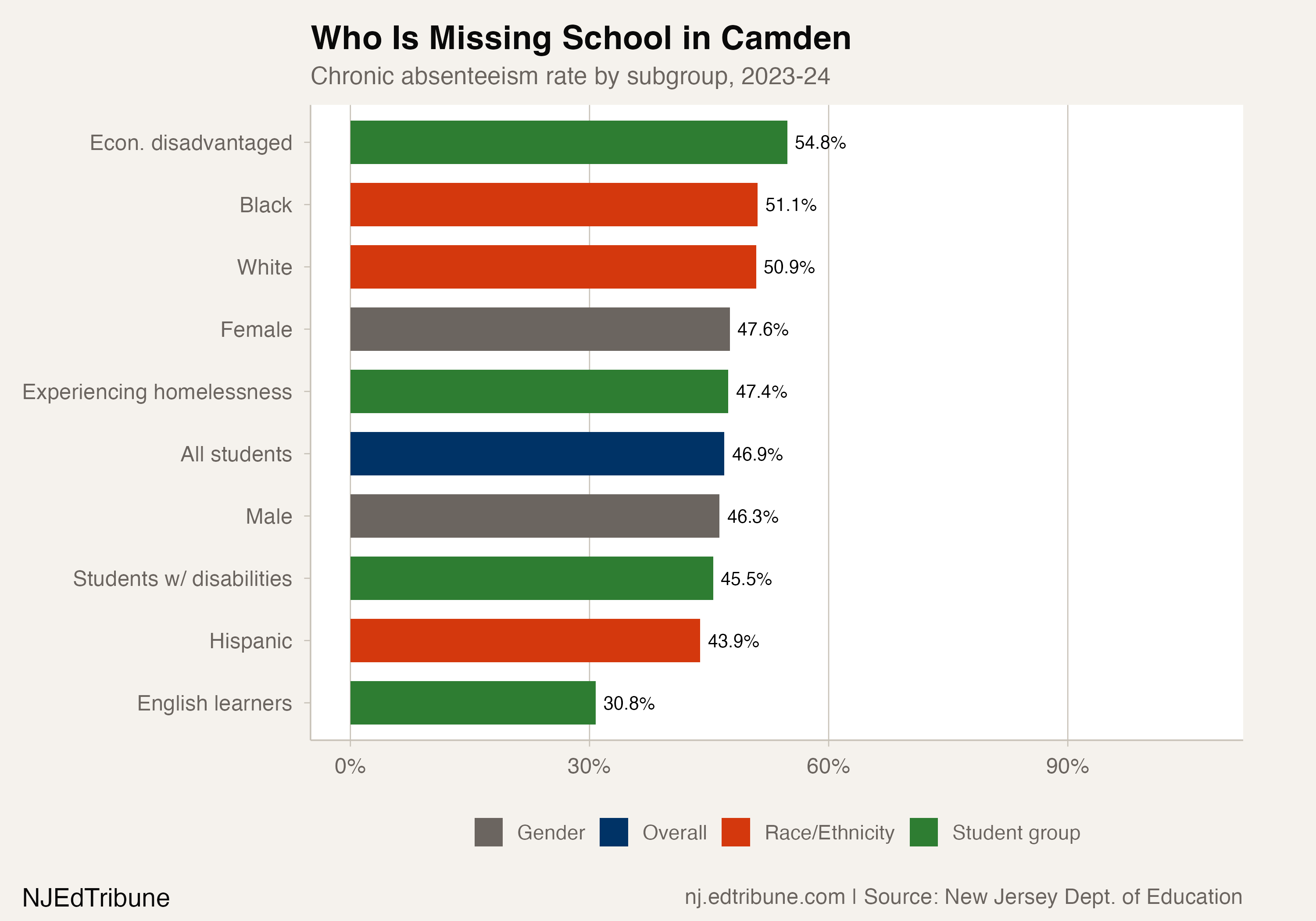
This inverted pattern is partly a function of Camden's demographics. White students make up a small share of enrollment, and the ones who remain in traditional public schools may face the same concentrated poverty and neighborhood instability as their peers. Economically disadvantaged students hit 54.8%, more than half chronically absent.
Separately, English learners had the lowest chronic absenteeism rate of any subgroup at 30.8%, roughly half the rate of other groups and the only subgroup below the district average by more than 10 points. This is consistent with patterns seen in other urban districts where recently arrived immigrant families prioritize attendance.
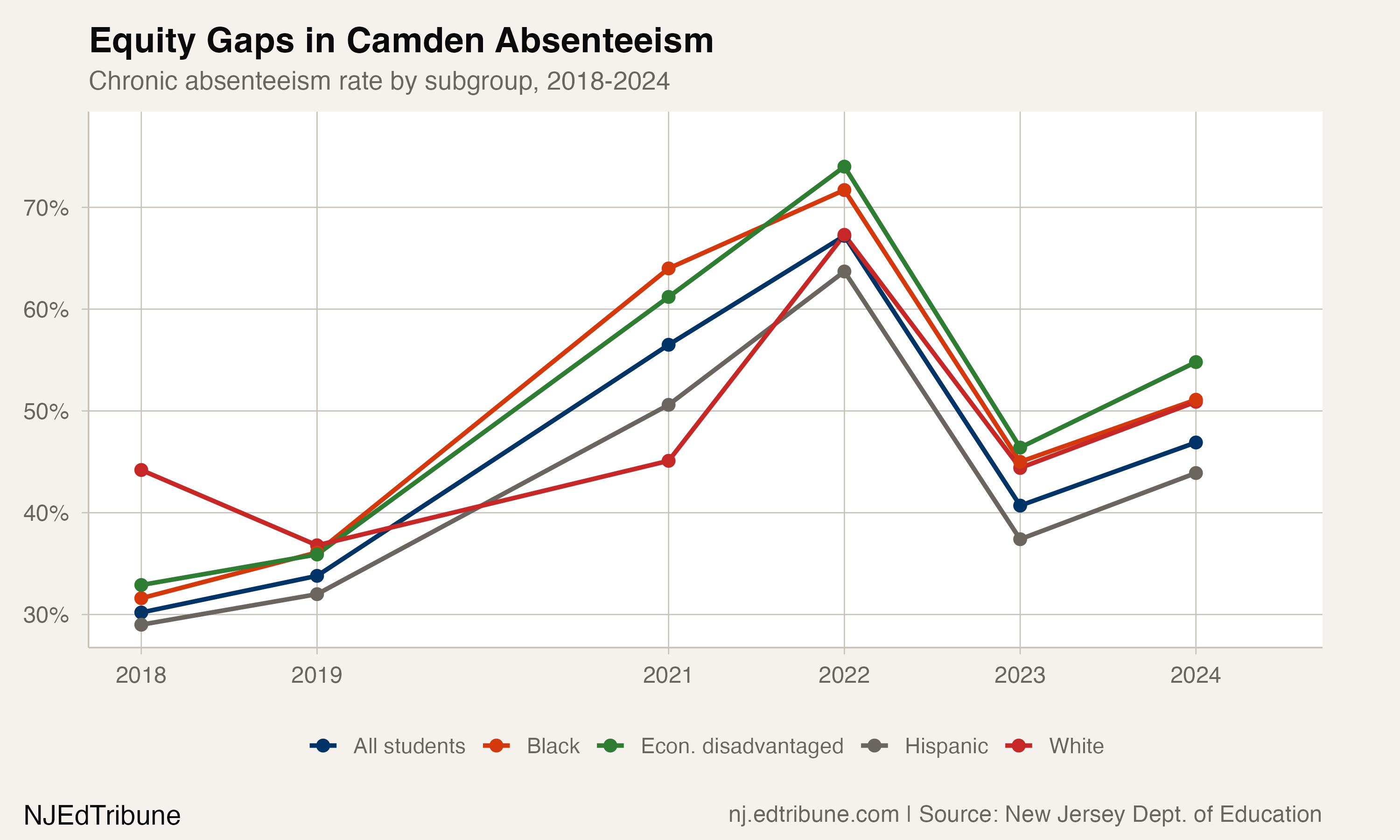
Every subgroup followed the same arc: spike in 2021-22, sharp recovery in 2022-23, partial reversal in 2023-24. But the reversal was not uniform. Economically disadvantaged students saw the largest increase from 2023 to 2024 (8.4 percentage points), while English learners saw the smallest (5.0 points). The gap between the most and least affected groups widened.
A district losing the resources to fight back
The attendance reversal arrives at the worst possible moment for Camden's capacity to respond. In April 2025, Superintendent Katrina McCombs announced plans to cut 289 positions to close a $91 million structural deficit, including attendance officers, behavior specialists, nurses, and security staff.
The deficit is driven by a structural mismatch. Traditional public school enrollment has fallen nearly 50% since the 2013 state takeover, from 11,660 students to 5,904, while payments to charter and Renaissance schools have risen from $54.9 million to $198.6 million. The district's fixed costs have not shrunk proportionally.
"Every member of our team plays an important role in supporting each and every one of our students." — Superintendent Katrina McCombs, WHYY, April 2025
McCombs stepped down in June 2025. The district launched a national superintendent search, and the State Board later approved Alfonso Q. Llano Jr. as superintendent effective March 1, 2026. Llano inherited a district where nearly half the students don't attend regularly, the budget for addressing it has been cut, and the state takeover that was supposed to transform outcomes has produced mixed results over 13 years: the graduation rate improved from 49% to 64.7%, but only 10.8% of students met state language arts expectations in 2022-23.
What the state is doing, and what it cannot reach
New Jersey signed legislation in January 2026 creating an 18-member Chronic Absenteeism Task Force, charged with studying root causes, reviewing discipline policies, and recommending legislative fixes within one year.
"Attendance is more than a statistic. It reflects whether students feel connected, supported, and safe." — Senator Angela V. McKnight, The Trentonian, January 2026
State law already requires districts with chronic absenteeism rates above 10% to develop corrective action plans, and pending legislation would mandate formal Attendance Review Teams. Camden's rate has never been below 10% in the available data.
The Renaissance schools that now serve more Camden students than the traditional district do are not immune. KIPP Cooper Norcross posted a 45.5% chronic rate in 2023-24, up from 21.1% before the pandemic. Camden Prep hit 50.2%. The absenteeism problem is citywide, not sector-specific.
Camden's 2022-23 recovery proved that intensive intervention -- door-to-door outreach, daily pledges, incentive programs -- can move the needle. Then the district cut 289 positions, including the attendance officers who made those door knocks. Llano inherited a budget that had eliminated the very staff whose work produced the only year of measurable progress in the available data. At Camden High, where 69.9% of students were chronically absent last year, there are now fewer adults in the building to notice when someone stops showing up.
Detailed code that reproduces the analysis and figures in this article is available exclusively to EdTribune subscribers.
Discussion
Sign in to join the discussion.
Loading comments...