At Bayonne Alternative High School, 86% of seniors were chronically absent in 2023-24. At Pinnacle Academy in Plainfield, it was 85%. At Camden Big Picture Learning Academy, 84%. These are the extremes. But the pattern they represent is not extreme at all. It is the most predictable feature of chronic absenteeism data in New Jersey: the older students get, the less they show up.
Across 430 high schools reporting twelfth-grade data in 2023-24, the average chronic absenteeism rate was 20.3%. One in five seniors missed at least 10% of the school year. The median was 18%. At 116 schools, more than a quarter of seniors were chronically absent. At 18 schools, it was more than half.
New Jersey's statewide graduation rate hit 91.3% in 2023-24, the highest since 2011. The two numbers sit side by side in the same data system, describing the same students, telling what appear to be two different stories.
The grade staircase
Chronic absenteeism in New Jersey follows a shape that researchers call a U-curve, though it looks more like a playground slide with a bump at the bottom. Pre-K sits highest at 29.7%, driven by the youngest children's vulnerability to illness and the absence of compulsory attendance in most pre-K programs. The rate drops sharply through the elementary grades, bottoming out at 4th grade (11.4%) and 5th grade (11.8%). Then it starts climbing through middle school and accelerates in high school, reaching 16.4% in 11th grade before jumping to 20.3% in 12th.
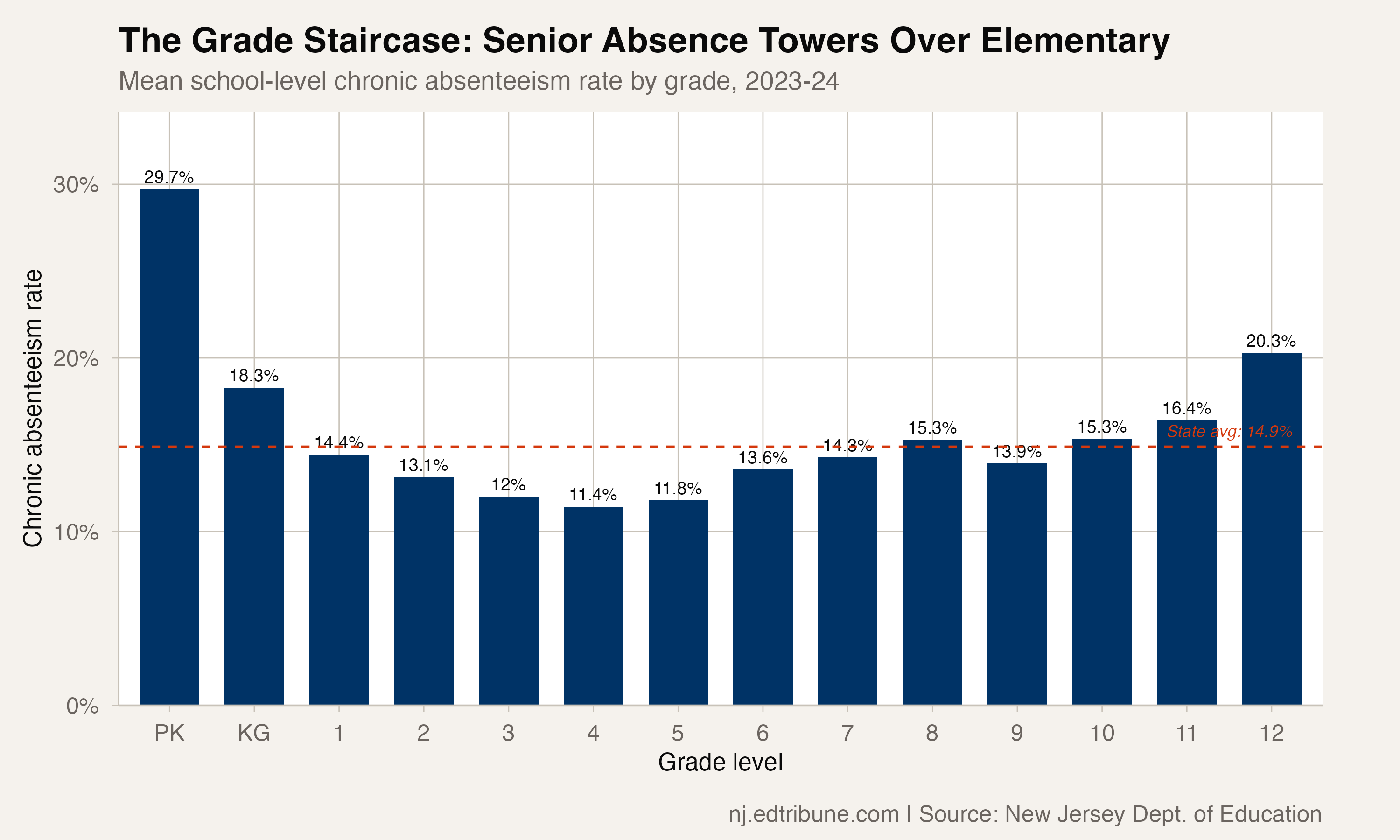
The gap between 3rd grade (12.0%) and 12th grade (20.3%) is 8.3 percentage points. The gap between 9th grade (13.9%) and 12th grade is 6.4 points. Even the one-year jump from 11th to 12th grade adds 3.9 points. No other consecutive-grade transition in the data comes close.
That 9th-grade number is worth pausing on. Ninth grade is where the research literature warns about a "transition wall" -- students entering high school from middle school, navigating new buildings, harder coursework, less supervision. The data does not bear it out. At 13.9%, 9th graders in New Jersey are actually slightly below the 8th-grade rate of 15.3%. The transition wall, at least in attendance data, belongs to seniors.
What happens in 12th grade
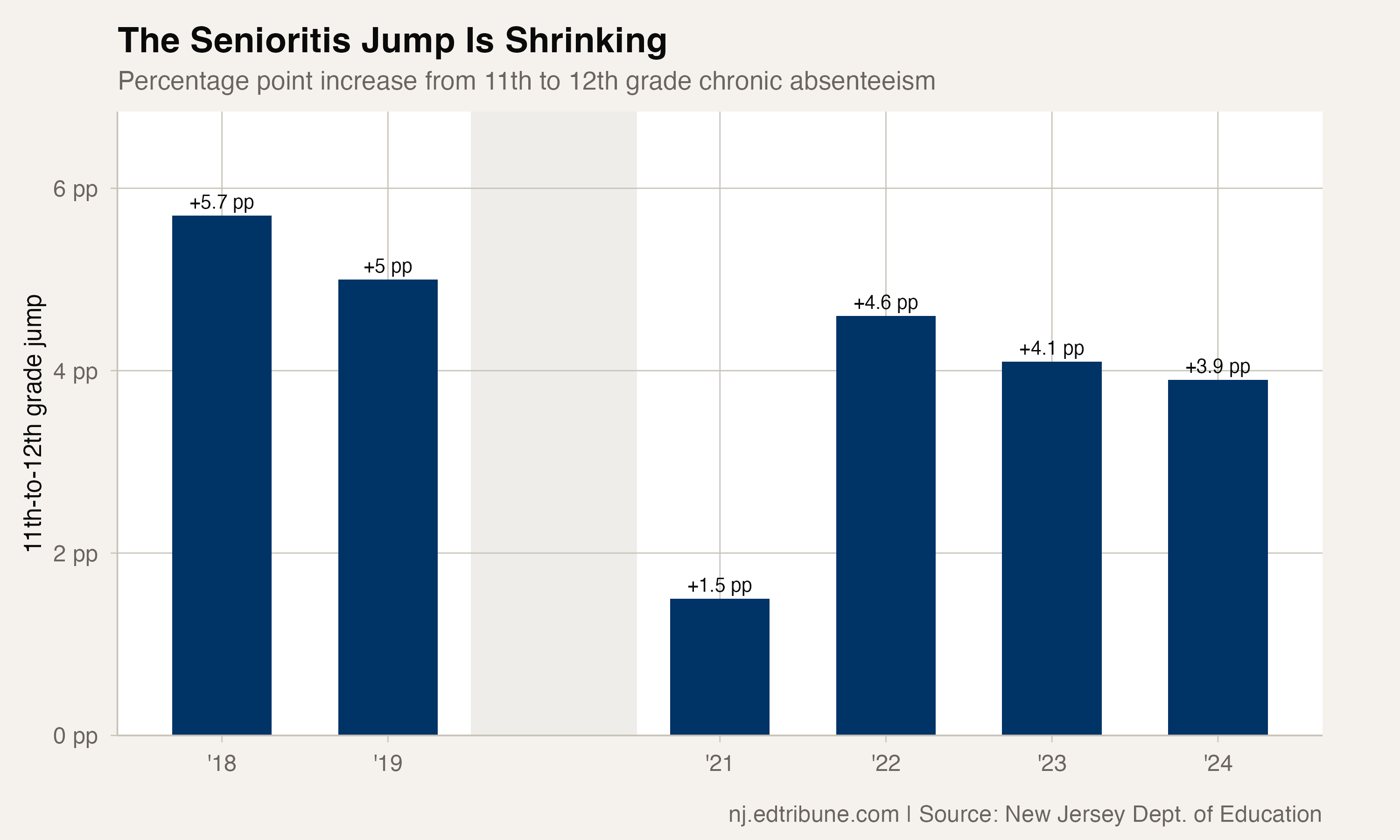
The 11th-to-12th-grade jump has been a fixture of New Jersey's attendance data since at least 2017-18, when the gap was 5.7 percentage points. By 2023-24, the jump had narrowed to 3.9 points. That is improvement, but it masks an important distinction: the gap shrunk primarily because 11th-grade absence worsened, not because 12th-grade absence improved.
In 2018-19, before the pandemic, the average twelfth-grade chronic rate was 19.8%. In 2023-24, it was 20.3%. The difference -- 0.5 percentage points over six years -- is small enough to be noise. Twelfth-grade chronic absenteeism was a 20% problem before COVID. It is a 20% problem now.
What COVID did was push the rate temporarily to 23.8% in 2021-22, then watch it fall back to nearly the same level. The pandemic spike and recovery look less like a disruption and more like a rubber band snapping back to its resting position.
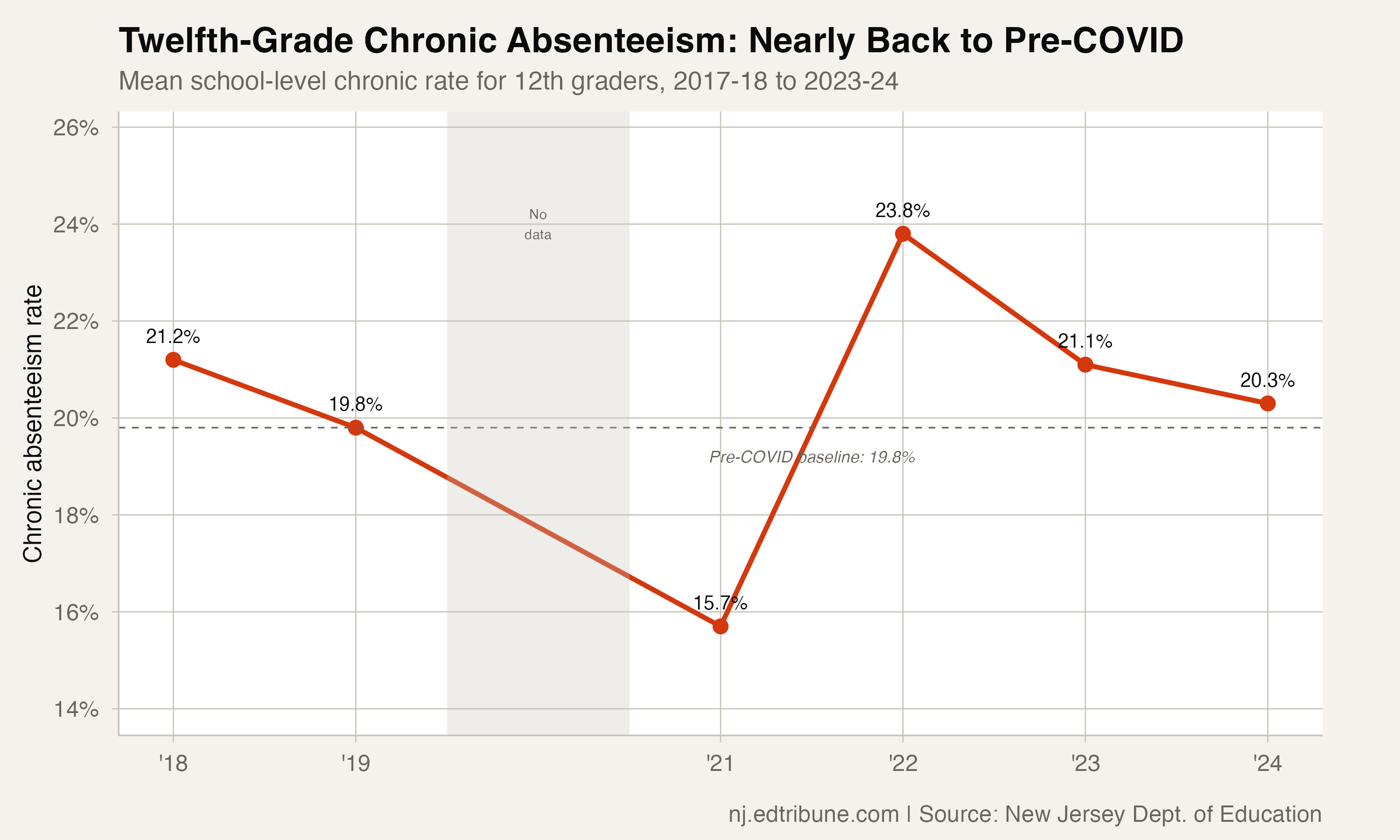
The year 2020-21 presents a curiosity. That was the first full year back from the pandemic shutdown (no 2019-20 data exists), and twelfth-grade chronic absence dropped to 15.7% -- well below the pre-COVID baseline of 19.8%. It was the lowest rate in the dataset. The 11th-to-12th-grade jump collapsed to just 1.6 points. The most likely explanation: virtual and hybrid learning made attendance easier to record, and schools measured participation differently. By 2021-22, when in-person schooling returned fully, the rate bounced to 23.8%.
The paradox: seniors recover, younger students don't
Here is the finding that complicates any simple narrative about senioritis. Twelfth grade has recovered 87% of its pandemic-era spike. Pre-K has recovered 88%. Those are the success stories. Kindergarten, by contrast, has recovered only 50%. Third grade has recovered 46%. The elementary grades that had the lowest chronic rates before COVID now carry the largest residual damage.
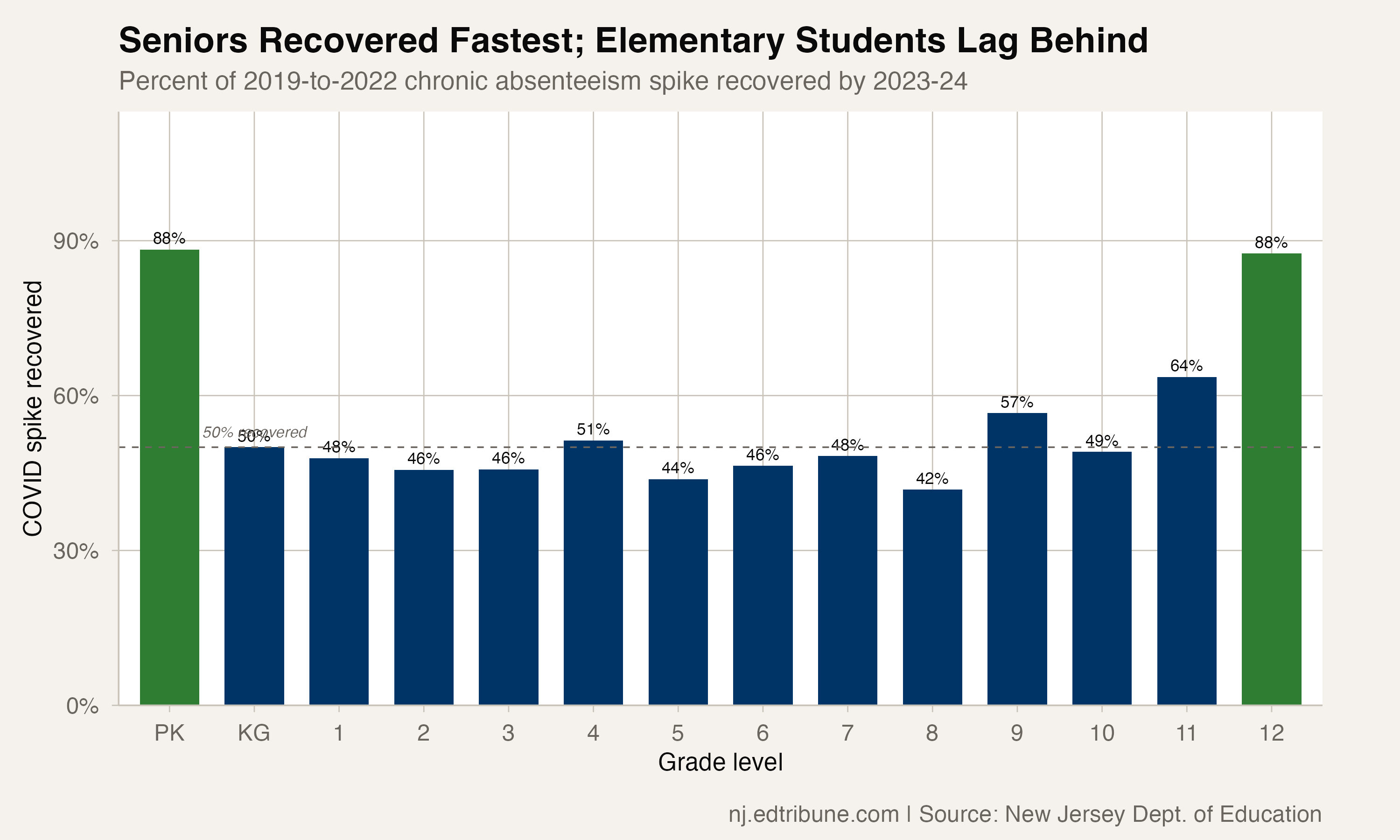
The gap between elementary and high school chronic absenteeism was 7.0 percentage points in 2018-19. By 2023-24, it had shrunk to 4.7 points. Not because high school improved dramatically, but because elementary school got worse and stayed worse.
This inversion matters for how schools allocate intervention resources. The traditional assumption -- that chronic absenteeism is primarily a high school problem requiring high school solutions -- needs updating. The rate is higher in high school. The growth is in elementary.
Four grades, four trajectories
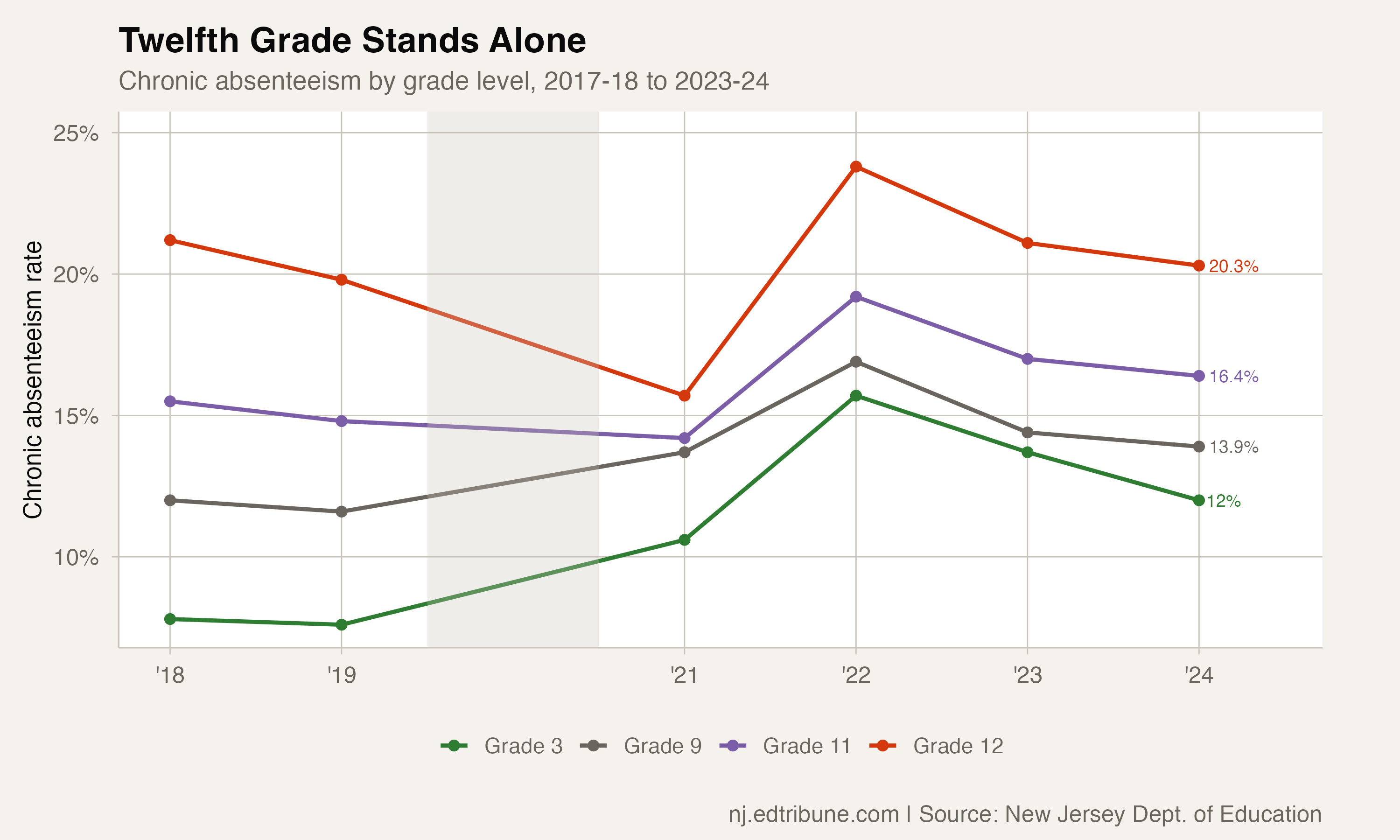
Tracking 3rd, 9th, 11th, and 12th grades across six years reveals how differently each grade level experienced the pandemic and its aftermath.
Third grade went from 7.6% (2018-19) to 15.7% (2021-22) and has only come back to 12.0%. The doubling was the story. The incomplete recovery is the ongoing one.
Ninth grade spiked modestly -- from 11.6% to 16.9% -- and recovered to 13.9%, still 2.3 points above its pre-COVID level.
Eleventh grade followed a similar arc: 14.8% to 19.2% to 16.4%, landing 1.6 points above baseline.
Twelfth grade went from 19.8% to 23.8% and sits at 20.3%, effectively back where it started. It was always the highest. COVID changed nothing about that.
The 89 schools where seniors show up
The distribution of 12th-grade chronic rates is wide enough to suggest that 20% is not inevitable. Across 430 high schools, 89 posted chronic absenteeism rates below 10% for their seniors. Bergen County Vocational, Eagle Academy in Newark, and the Union County Academy for Allied Health Sciences reported rates at 0% or 1%. County vocational-technical schools appear disproportionately in the low-absence group, likely because students in career programs have a clear connection between attendance and outcomes.
At the other end, 80 schools exceeded 30%, and 18 exceeded 50%. The schools with the highest rates are concentrated in the Abbott districts -- Camden, Paterson, Trenton -- and in alternative education programs designed for students who have already disconnected from traditional schooling.
The median school-level rate of 18% is lower than the mean of 20.3%, indicating that a tail of high-absence schools pulls the average up.
What the graduation rate does not explain
New Jersey's 91.3% four-year graduation rate sits alongside a 20.3% senior chronic absenteeism rate, and the two numbers do not obviously reconcile. One in five seniors misses at least 10% of instructional days, yet more than nine in ten graduate on time.
The gap between those figures is not a data error. It reflects how chronic absenteeism and graduation requirements measure different things. A student can be chronically absent -- missing 18 of 180 days -- and still accumulate enough credits and seat time to graduate. Chronic absenteeism is a threshold measure, not a disqualifier. It flags risk, not failure.
Whether those students are learning as much as their attendance-regular peers is a question the chronic absenteeism data cannot answer. What it can say is that the behavior pattern researchers call "senioritis" -- declining engagement once students believe graduation is assured -- is not a myth in New Jersey. It is a 20% rate that predates the pandemic, survived it, and shows no sign of shrinking.
A 91.3% graduation rate and a 20.3% senior chronic absenteeism rate appear in the same data system, describing the same students, in the same school year. One number says New Jersey's high schools are working. The other says one in five seniors has functionally disengaged from daily attendance. Both are true. The distance between them measures how much a student can miss and still receive a diploma -- and how little the diploma, on its own, reveals about whether a student was actually there.
Detailed code that reproduces the analysis and figures in this article is available exclusively to EdTribune subscribers.
Discussion
Sign in to join the discussion.
Loading comments...