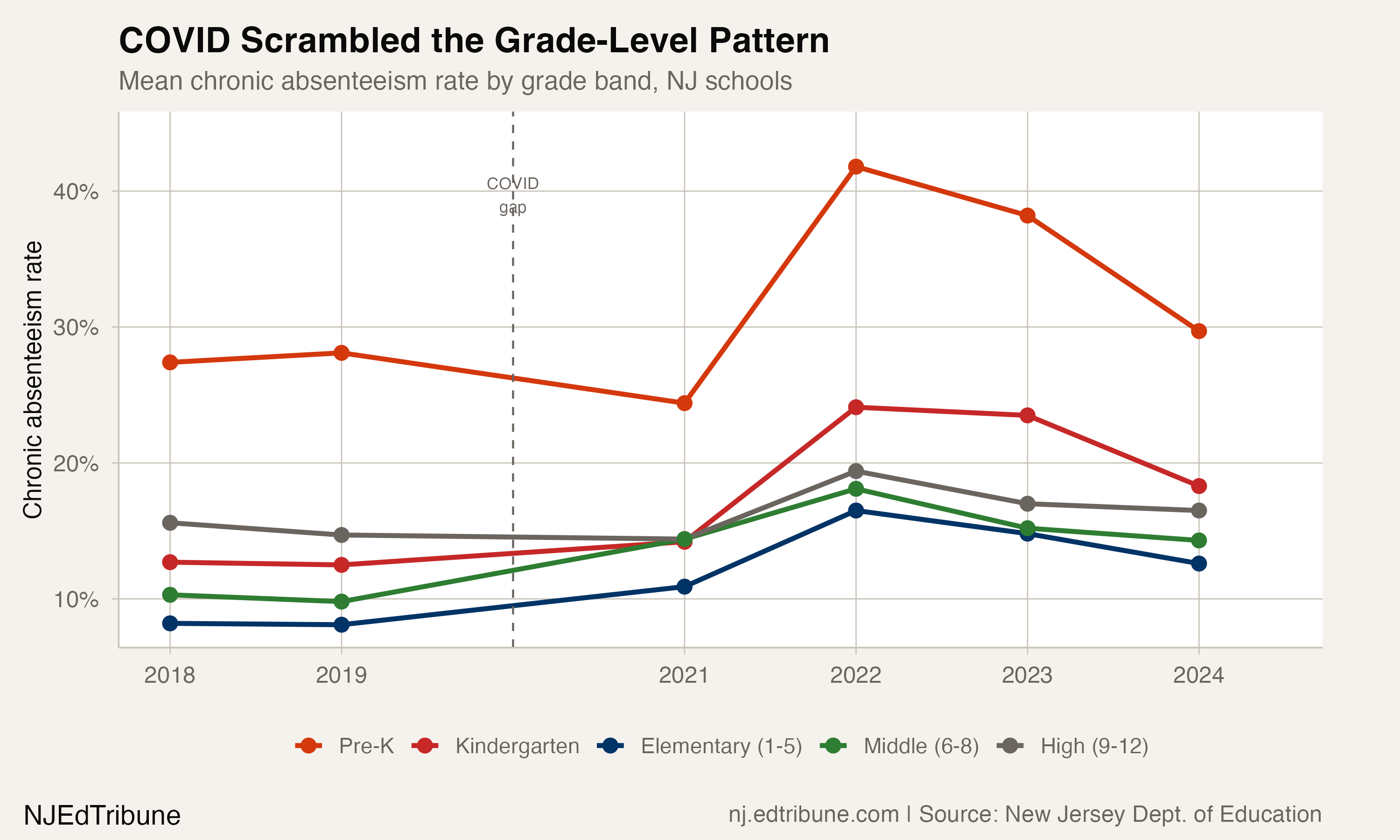
In 2019, a kindergartner in New Jersey was roughly as likely to be chronically absent as a sixth-grader, and far less likely than a high school senior. The grade-level hierarchy was stable and predictable: high schools ran the worst chronic absenteeism rates at 14.7%, elementary schools the best at 8.1%.
COVID demolished that order. By 2022, kindergarten chronic absenteeism had nearly doubled to 24.1%, vaulting past high school's 19.4%. Two years of recovery have not restored the old pattern. Kindergarten sits at 18.3% in 2024, still 5.8 percentage points above its pre-COVID rate. High school, by contrast, has recovered 61.7% of its COVID spike and is only 1.8 points above where it started.
The youngest students got hit hardest and are healing slowest.
What kindergarten looks like at 18.3%
At 18.3%, roughly one in five kindergartners across New Jersey missed 18 or more days of the 180-day school year. That matters more in kindergarten than in almost any other grade. Federal research has found that chronic absence in the early grades disrupts foundational literacy and numeracy, increases the likelihood of grade repetition, and predicts behavioral problems in later years.
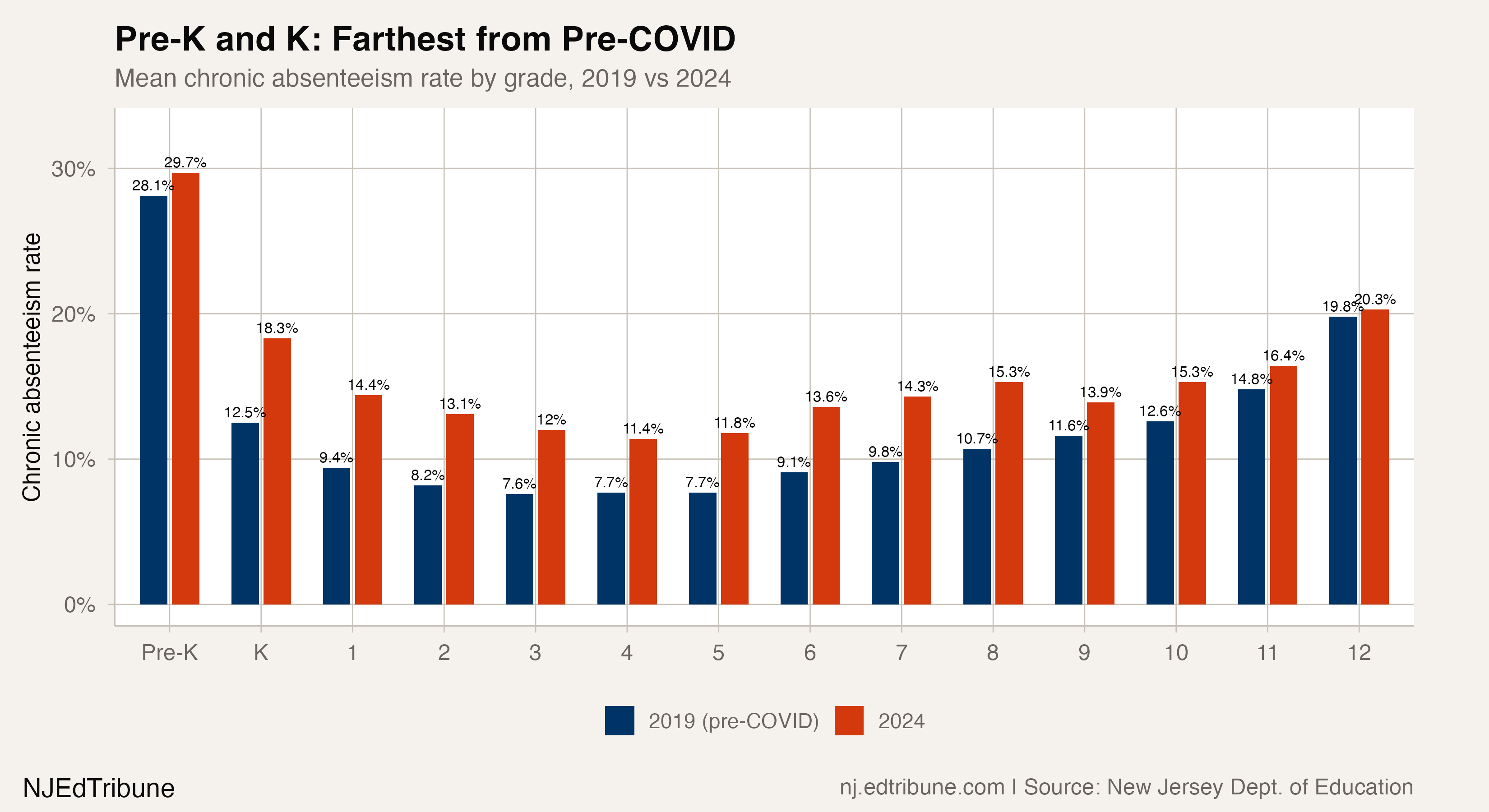
The gap is not abstract. First grade chronic absenteeism in 2024 was 14.4%, up from 9.4% pre-COVID, a 5.0 percentage point increase. Second grade: 8.2% to 13.1%, a 4.9 point jump. Third grade: 7.6% to 12.0%, a 4.4 point increase. The damage fades as you move up the grade ladder, but in every elementary grade, the chronic rate is at least 35% higher than it was in 2019.
The pre-K problem dwarfs everything else
Pre-K operates on a different scale entirely. At 29.7% in 2024, nearly one in three pre-K students is chronically absent. That figure has actually recovered substantially from its 2022 peak of 41.8%, when two in five pre-K students were missing more than 10% of school days. The 88.3% recovery rate is the best of any grade band.
But the baseline was already catastrophic. Pre-K chronic absenteeism was 28.1% before the pandemic. The problem did not start with COVID; COVID just made it worse.
New Jersey's Department of Education has acknowledged the challenge, noting that even two absences per month push a student into chronic territory. For pre-K, where parents make every attendance decision, the NJDOE and federal Regional Educational Laboratory Mid-Atlantic partnered to create a "Go-Learn-Grow" toolkit specifically targeting the youngest learners' families. Schools are not required to include pre-K students in their corrective action calculations for chronic absenteeism, which may reduce the urgency districts feel to address the issue.
Why younger grades broke worse
The mechanisms that drive elementary absence are different from those that drive high school absence. High schoolers skip. They disengage, take jobs, or drift out. The interventions for older students center on relevance, credit recovery, and engagement.
For kindergartners and first-graders, the decision to attend school belongs to their parents. The pandemic disrupted those parental habits in ways that have proven sticky. Parents who kept young children home for 18 months recalibrated what counts as "sick enough to miss school." Mild colds, low-grade fevers, and vague complaints that would have sent a pre-COVID kindergartner to school now keep them home.
A 2024 RAND survey of district leaders found that for younger students, administrators emphasized the need to establish attendance as a shared family routine early, noting that bad attendance habits formed in kindergarten create persistent problems in later grades. For high schoolers, the same survey found interventions focused more on engagement and relevance to future plans.
There is also a structural difference. High school students have their own transportation, their own social motivation to attend, and course-credit requirements that create consequences for absence. Kindergartners depend entirely on adults who may be juggling shift work, childcare for younger siblings, or transportation barriers. New Jersey law entitles K-8 students living two or more miles from school to district-provided transportation, and busing closures are classified as state-excused absences under administrative code, adding another layer of complexity to how transportation barriers show up in the data.
The recovery gap, grade by grade
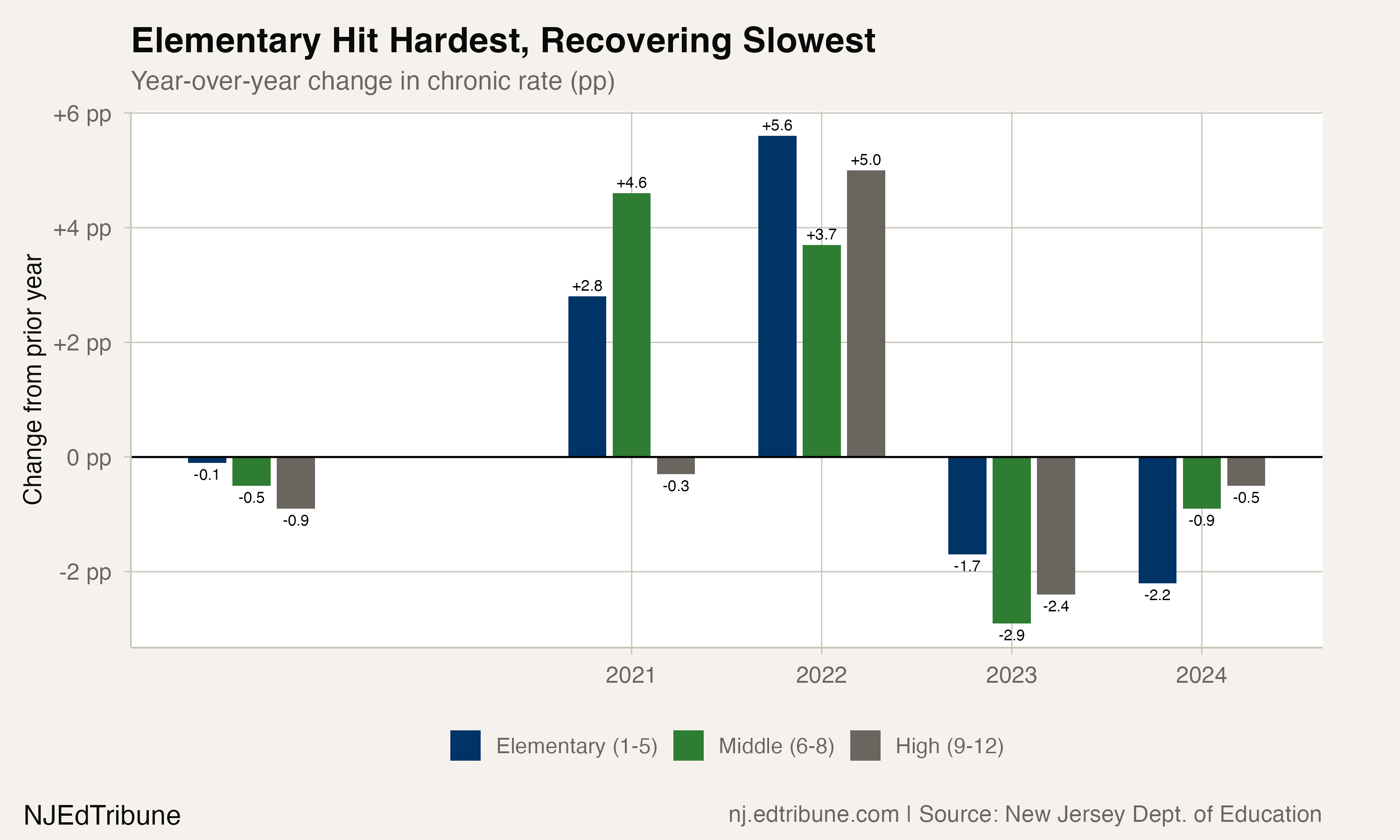
The recovery data tells a sharper story than the raw rates. High school (9-12) has recovered 61.7% of its COVID-era spike, bringing its chronic rate from 19.4% to 16.5%. Elementary (1-5) has recovered only 46.4%, from 16.5% to 12.6%. Kindergarten sits at exactly 50%.
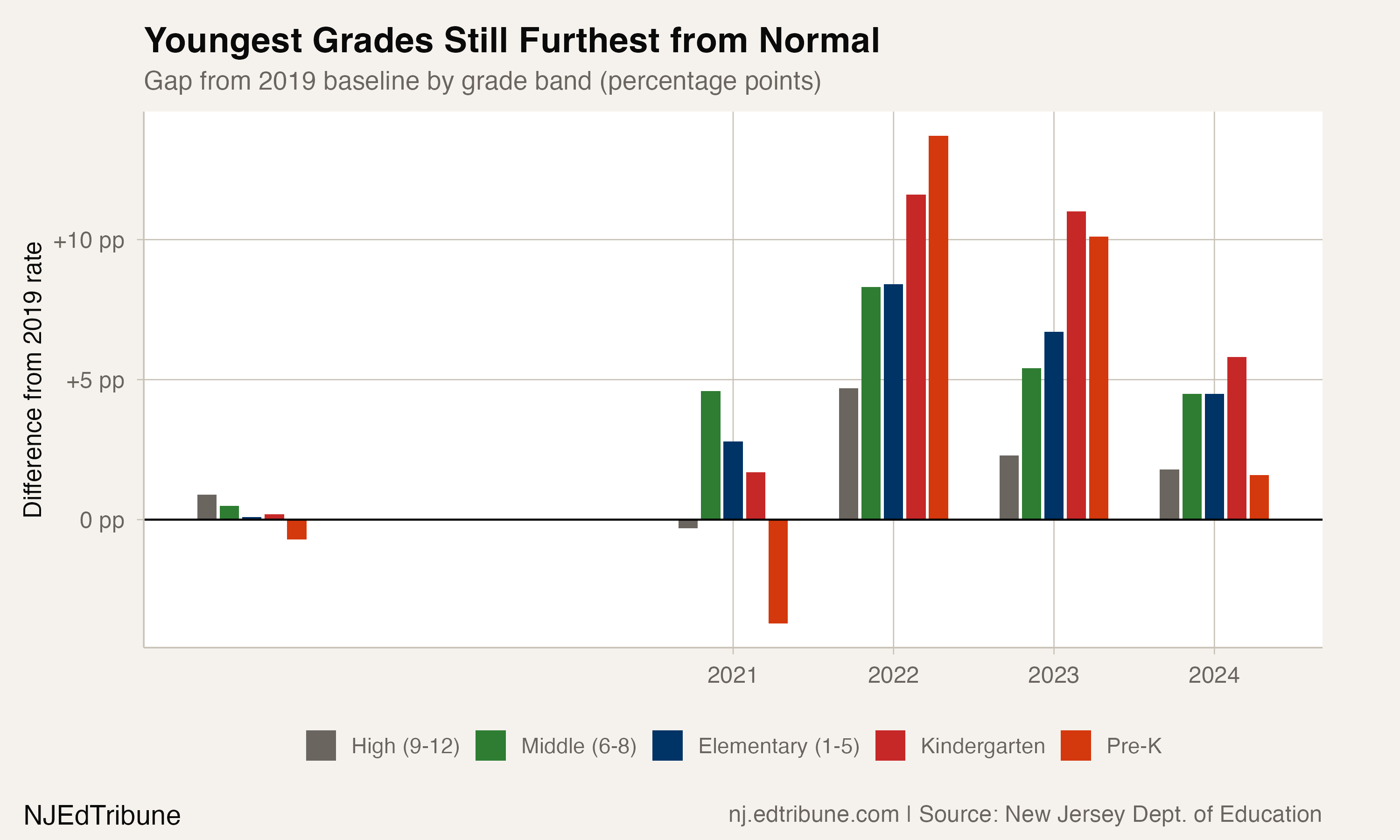
The pattern is not just about where each grade band peaked. It is about how far each had to fall. High school's COVID spike was 4.7 percentage points (14.7% to 19.4%). Elementary's was 8.4 points (8.1% to 16.5%). Kindergarten's was 11.6 points (12.5% to 24.1%). The grade bands that were best-behaved before the pandemic absorbed the worst shocks during it.
That asymmetry means elementary schools are still carrying a burden they were never built for. An elementary school at 12.6% chronic absenteeism has roughly 55% more students missing extensive time than it did five years ago. The staffing models, intervention resources, and family engagement practices designed for a school at 8% may not fit a school at 12.6%.
Newark offers a counterexample, not a template
Newark Public Schools has driven its districtwide chronic rate down to 10.4% in 2024-25, with elementary students at 8.8%. Superintendent Roger León credited the district's Office of Attendance, Truancy Task Force, and attendance counselors for the improvement, which marks three consecutive years of decline. Newark's model involves direct family contact by teachers and incentive programs for at-risk students.
Whether that model can transfer to suburban and rural districts with different demographics, budgets, and family structures is an open question. Newark has federal and state intervention resources that most New Jersey districts do not. The district's success is real and documented, but replicating it requires resources that most of the state's 649 districts cannot access at the same scale.
The kindergarten gap
Kindergarten chronic absenteeism was 12.5% in 2019. It was 18.3% in 2023-24. That 5.8 percentage point gap is the largest residual increase of any grade band except pre-K, and it matters more than pre-K's because kindergarten is where compulsory education begins in New Jersey, where foundational literacy instruction starts, and where attendance habits form that persist through elementary school.
Spread across roughly 1,300 schools, 18.3% means thousands of five- and six-year-olds are missing more than 18 days a year. Their parents are making the attendance decision for them. The pandemic taught those parents that keeping a mildly sick child home was responsible, that a day missed here and there was not consequential, that school would be there tomorrow. Two years of recovery data suggest that lesson stuck.
Detailed code that reproduces the analysis and figures in this article is available exclusively to EdTribune subscribers.
Discussion
Sign in to join the discussion.
Loading comments...