In Haddon Township, a Camden County suburb where the overall student body misses school at a rate of 8.4%, students who are currently homeless are chronically absent at 73.3%. That is not a typo. The district's students who are currently homeless miss school at 8.7 times the rate of their peers, the widest gap of any district in the state.
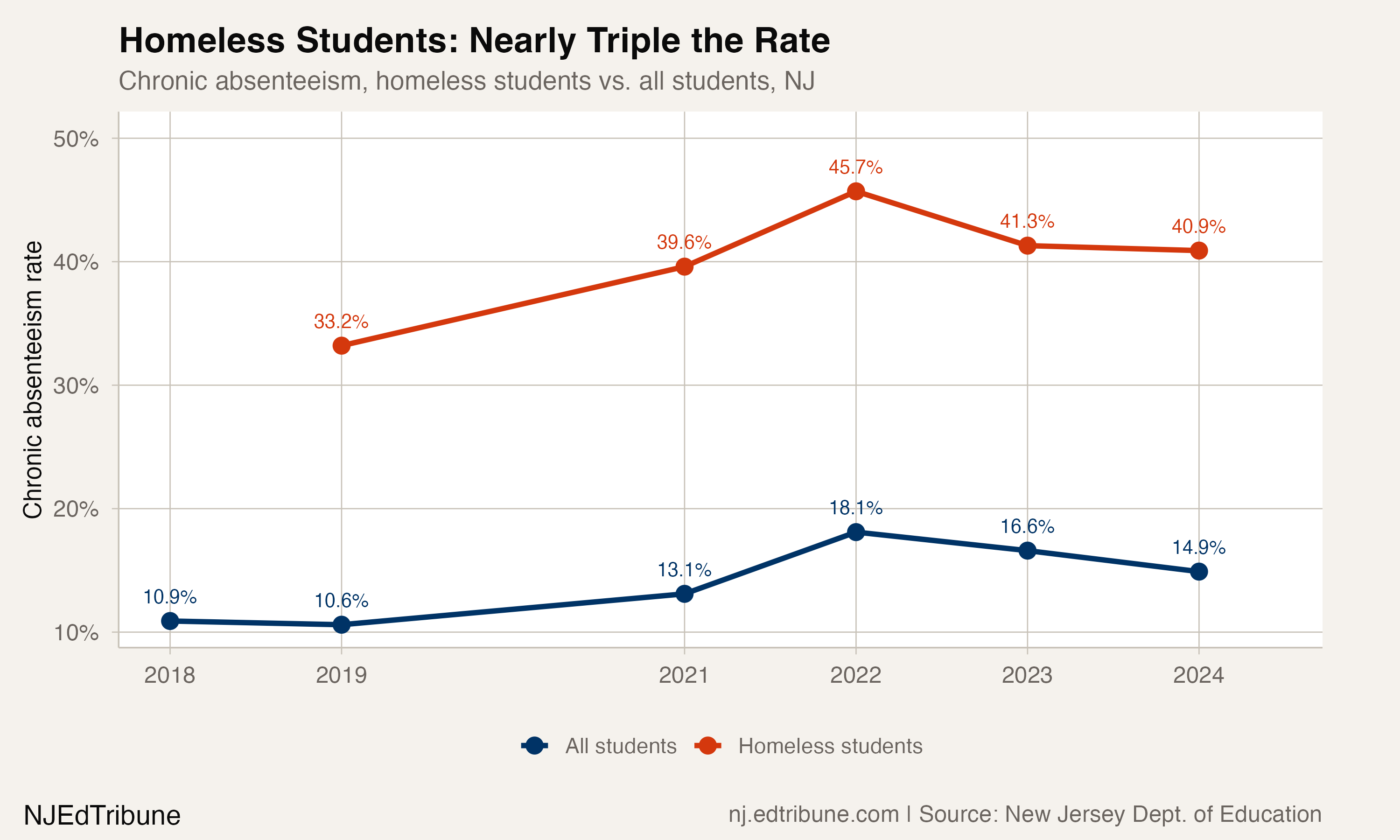
Haddon Township is an extreme case, but it is not an outlier in kind. Across New Jersey, 40.9% of students experiencing homelessness were chronically absent in 2023-24, nearly triple the 14.9% statewide average. That 26-percentage-point gap is the largest for any subgroup the state tracks, exceeding the gaps for students in foster care, students with disabilities, and every racial and ethnic group.
The state's overall chronic absenteeism rate has been improving. It peaked at 18.1% in 2021-22, the worst pandemic-era year, and has since fallen to 14.9%, closing in on the pre-pandemic baseline of 10.6%. But for students who are currently homeless, the recovery has barely registered: their rate peaked at 45.7% in 2021-22, fell to 41.3% in 2022-23, and dropped just 0.4 percentage points further to 40.9% in 2023-24. The state got better. The students who needed it most did not.
A gap that widened and stayed wide
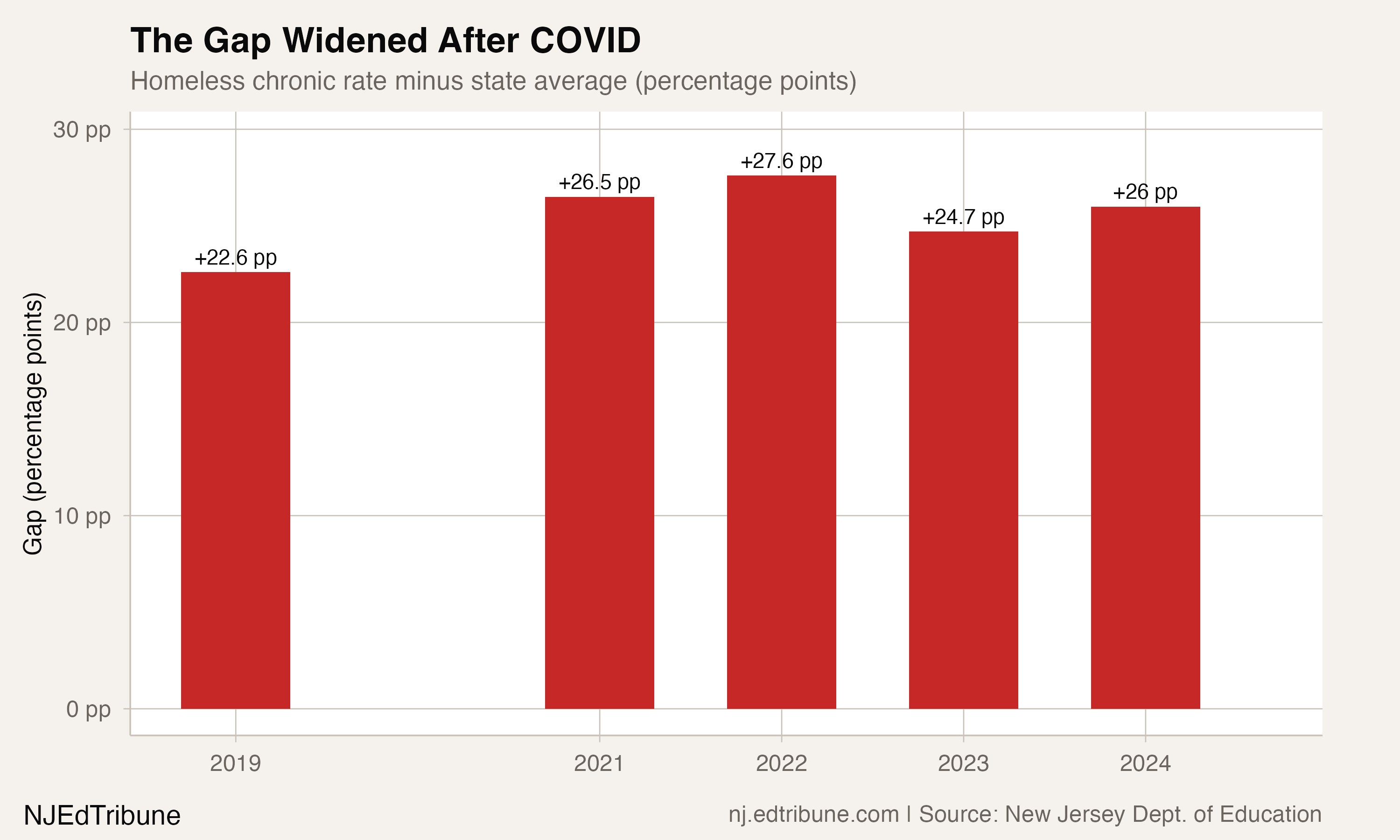
Before the pandemic, the distance between students who are currently homeless and the state average was already large: 22.6 percentage points in 2018-19. Then COVID hit. By 2021-22, the gap had swelled to 27.6 points as the homeless rate spiked to 45.7% while the state average climbed to 18.1%.
What happened next is the telling part. As the state average recovered, falling from 18.1% to 14.9% over two years, the homeless rate barely moved. The gap in 2023-24 stands at 26.0 percentage points, wider than before the pandemic. Whatever forces are pulling the broader student population back into regular attendance are not reaching students who are currently homeless with the same force.
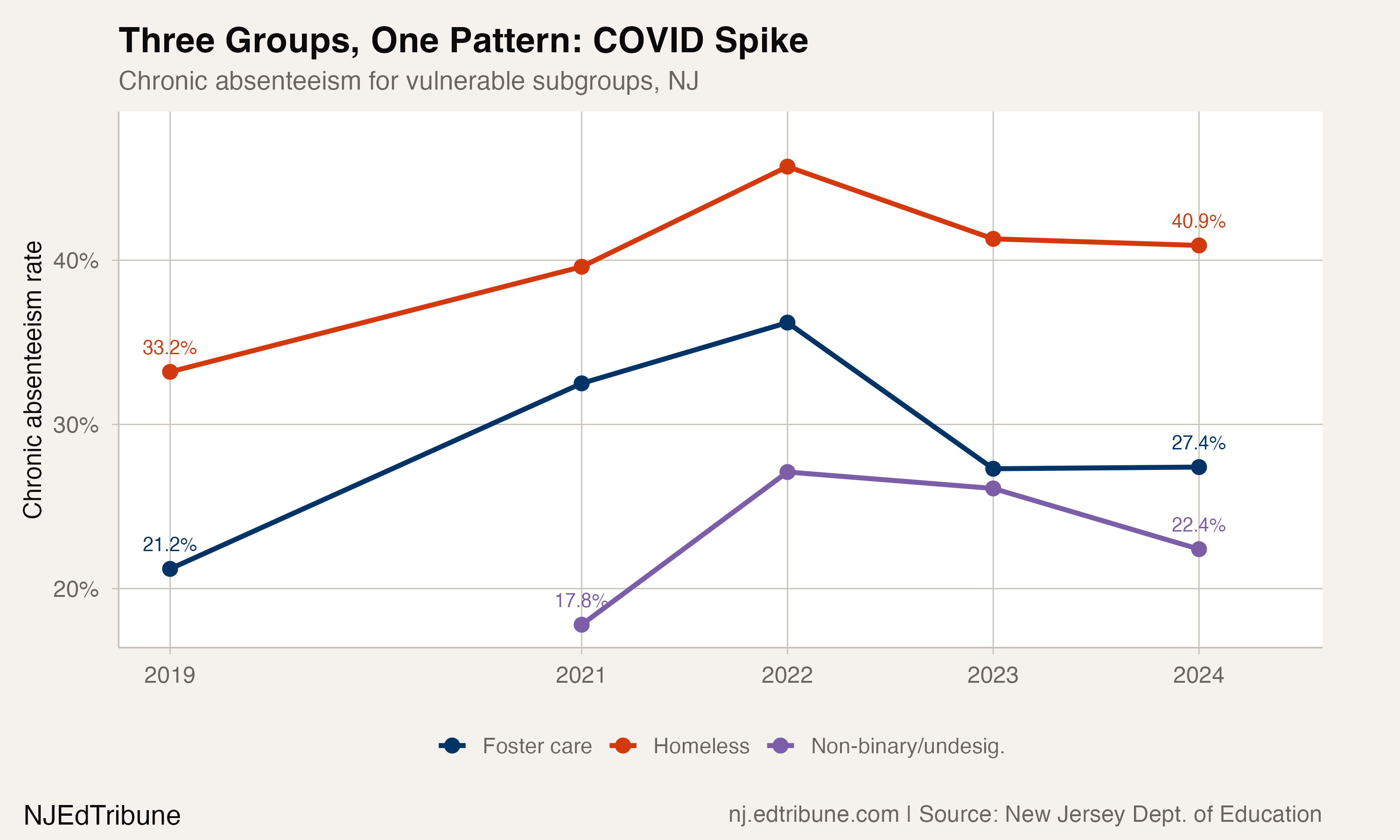
This pattern is not unique to homelessness. Students in foster care followed a similar trajectory: 21.2% in 2018-19, spiking to 36.2% in 2021-22, recovering to 27.4% in 2023-24. Students identified as non-binary or gender-undesignated, a category first tracked in 2020-21, peaked at 27.1% in 2021-22 and have come down to 22.4%. All three groups spiked during COVID and have partially recovered, but none has returned to pre-pandemic levels.
The hierarchy of absence
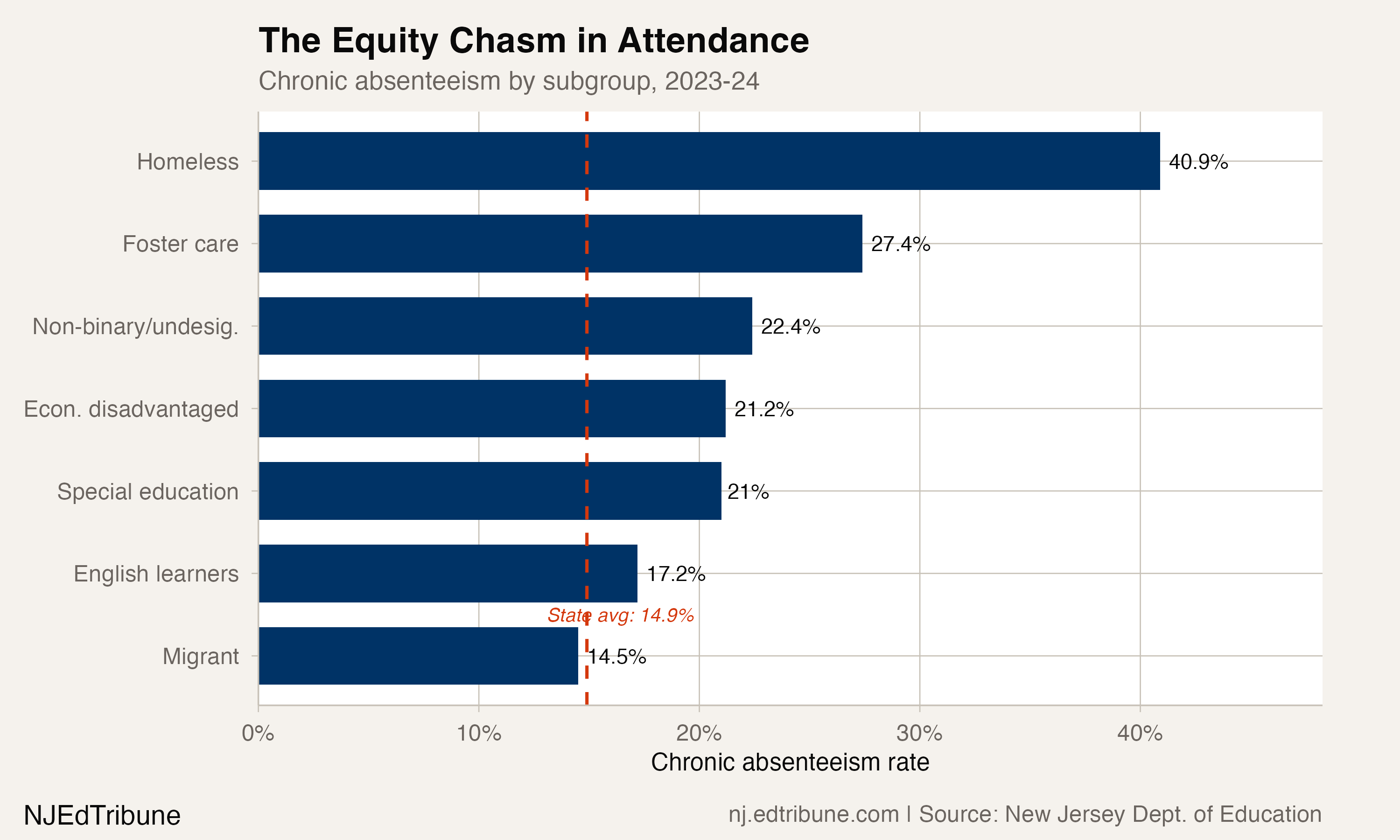
New Jersey tracks chronic absenteeism across 17 subgroups. In 2023-24, the ranking is stark. Students who are currently homeless sit alone at the top at 40.9%, followed by foster care at 27.4% and non-binary/undesignated students at 22.4%. Black students (21.4%), students who are economically disadvantaged (21.2%), and students with disabilities (21.0%) cluster in the low 20s. White students are at 11.4%, and Asian/Pacific Islander students at 7.3%.
Note that these categories overlap substantially. Many students who are currently homeless are also counted in the economically disadvantaged subgroup, and racial categories cross-cut all service populations. A Black student experiencing homelessness appears in both tallies. The 40.9% homeless rate and the 21.4% Black rate are not additive; they measure different slices of the same student body.
New Jersey has historically ranked among the states with the lowest chronic absenteeism rates nationally, according to American Enterprise Institute tracking. That national context makes the homeless gap more pointed: even in a state that is broadly succeeding at attendance, the most unstably housed students are missing two out of every five school days.
Why the rate resists recovery
The most direct explanation is housing instability itself. A student who changes shelter placements, doubles up with relatives in a different town, or sleeps in a car faces a transportation problem that no attendance intervention can solve. Under the McKinney-Vento Act, districts must provide transportation to a student's school of origin, but the logistics of busing a child across district lines are expensive and slow to arrange.
New Jersey's broader homelessness picture has been worsening. The 2024 Point-in-Time Count found 12,680 people experiencing homelessness statewide, a 23.5% increase from 10,267 the prior year. The top causes: being asked to leave a shared residence (1,808 people), eviction or risk of eviction (1,537), and job income loss (1,387). The state faces a shortage of 214,475 homes for extremely low-income households, per the same report. Rising housing instability in the adult population flows directly into the student population: more families doubled up, more frequent moves, more missed school days.
A competing explanation is that the rate reflects identification changes rather than worsening conditions. As districts improve their McKinney-Vento identification practices, they may be capturing students who were previously uncounted, students who were already chronically absent but not flagged as homeless. If the denominator of identified students who are currently homeless is growing faster among those with attendance problems, the rate would rise even if conditions held steady. The data cannot distinguish between these possibilities.
Inside the districts
Across 210 districts reporting homeless chronic absenteeism data, the median district sees its students who are currently homeless miss school at 2.4 times the rate of the overall student body. In 53 districts, more than half of all students who are currently homeless are chronically absent.
The scatter plot below tells the story district by district. The dashed line marks parity: points above it represent districts where students who are currently homeless are absent at higher rates than the overall population. Nearly every district falls above the line, but the distance varies enormously. In Haddon Township, the multiplier is 8.7x. In East Brunswick, 6.1x. In Montclair, 5.2x.
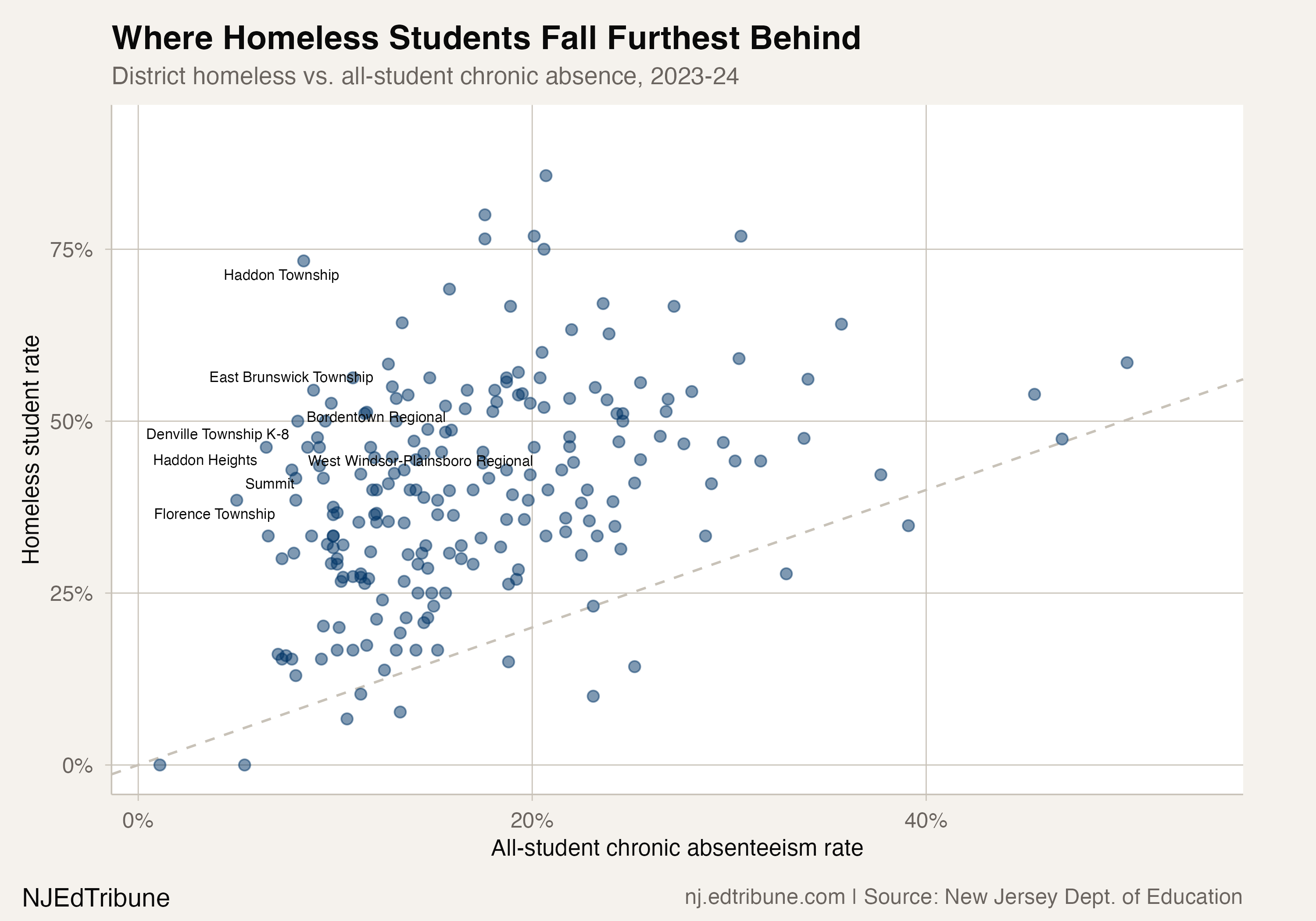
These are suburban districts with low overall absence rates. When the baseline is 8% or 9%, even a modest number of students who are currently homeless missing school pushes the subgroup rate to 50% or higher. Paterson, by contrast, has a high overall rate (35.7%) and a homeless rate of 64.1%, a multiplier of just 1.8x. The gap is smaller not because Paterson's students who are currently homeless are doing better, but because its entire student body is doing worse.
At the other end, 20 districts report homeless chronic absenteeism below 20%, with Washington Borough at 6.7% and Lower Township Elementary at 7.7%. These are small-sample districts where a handful of students can swing the rate dramatically, but they suggest that the 40.9% statewide figure is not an inevitable floor.
What the state is doing
New Jersey has responded to the broader chronic absenteeism crisis, if not to the homeless-specific gap. In December 2025, Lt. Gov. Tahesha Way signed legislation creating a 17-member Chronic Absenteeism Task Force directed to study root causes and develop recommendations within one year. The law specifically requires examining disparities among vulnerable populations, including students who are currently homeless.
"The house is on fire here when you have that percentage of students missing 18 days or more." -- State Board of Education member Nedd Johnson, Chalkbeat, April 2024
The NJ4S (Statewide Student Support Services) network, launched in 2023-24, has reached approximately 39,000 individuals through 1,223 Tier 1 programs in its first 100 days, with 498 schools across 295 districts signed up for services. But NJ4S is designed as a mental health and prevention platform. Its services target disengagement and school aversion, two of the four root cause categories the state has identified. For a student whose primary barrier is that they do not have a stable place to sleep, mental health services address a symptom, not the cause.
Districts where chronic absenteeism exceeds 10% are required to develop corrective action plans under state law. These are structural policies that benefit all students. What the data suggests is that students who are currently homeless need something more targeted: transportation that actually arrives, liaisons who track families across shelter moves, and housing stability that no school district can provide on its own.
The question the data raises
The statewide chronic absenteeism rate has fallen 3.2 percentage points from its pandemic peak. For students who are currently homeless, it has fallen 4.8 points. In absolute terms, they have improved more. In relative terms, they started so far behind that the improvement barely registers.
Newark has experimented with incentive-based attendance programs offering game tickets and gift cards to students who meet attendance goals. But as one expert quoted in Chalkbeat noted, students who are "severely chronically absent may need more intensive support to address their attendance issues." New Jersey is short 214,475 homes for extremely low-income households. No attendance incentive program fills that gap. For students who are currently homeless, the barrier is not motivation. It is a place to sleep and a ride to school.
Detailed code that reproduces the analysis and figures in this article is available exclusively to EdTribune subscribers.
Discussion
Sign in to join the discussion.
Loading comments...