New Jersey is building one of the most ambitious preschool systems in the country. Roughly 80,000 three- and four-year-olds now attend free, state-funded pre-K across more than half the state's elementary-serving districts, with legislation signed in July 2025 pushing toward full universality by 2030.
There is just one problem with the plan: nearly a third of the children who show up for pre-K do not show up enough.
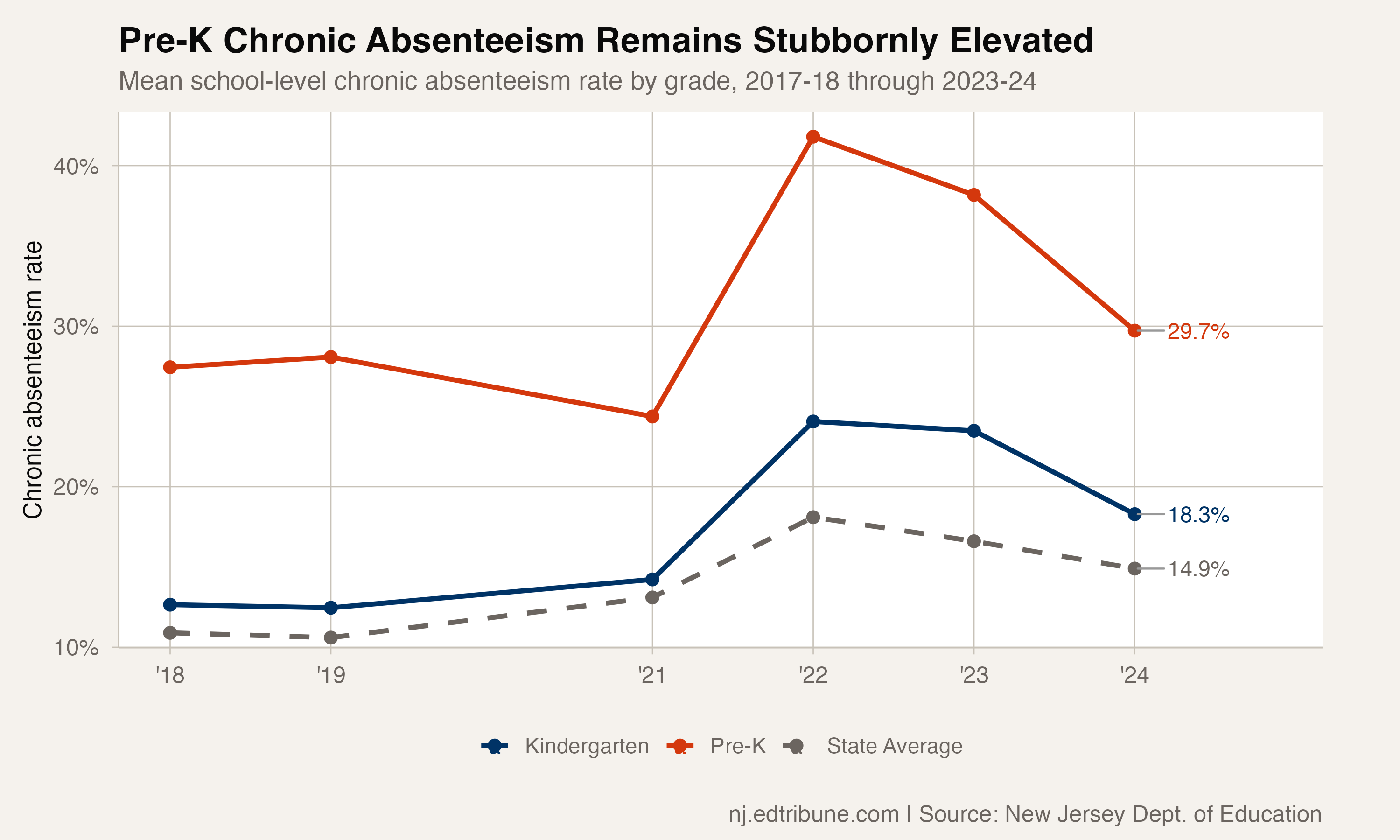
In 2023-24, the average pre-kindergarten chronic absenteeism rate across New Jersey schools was 29.7%. That means close to one in three pre-K students missed 10% or more of the school year, the state's threshold for chronic absence. The rate is down from 41.8% during the pandemic peak in 2021-22, but it remains 1.6 percentage points above the pre-COVID baseline of 28.1%.
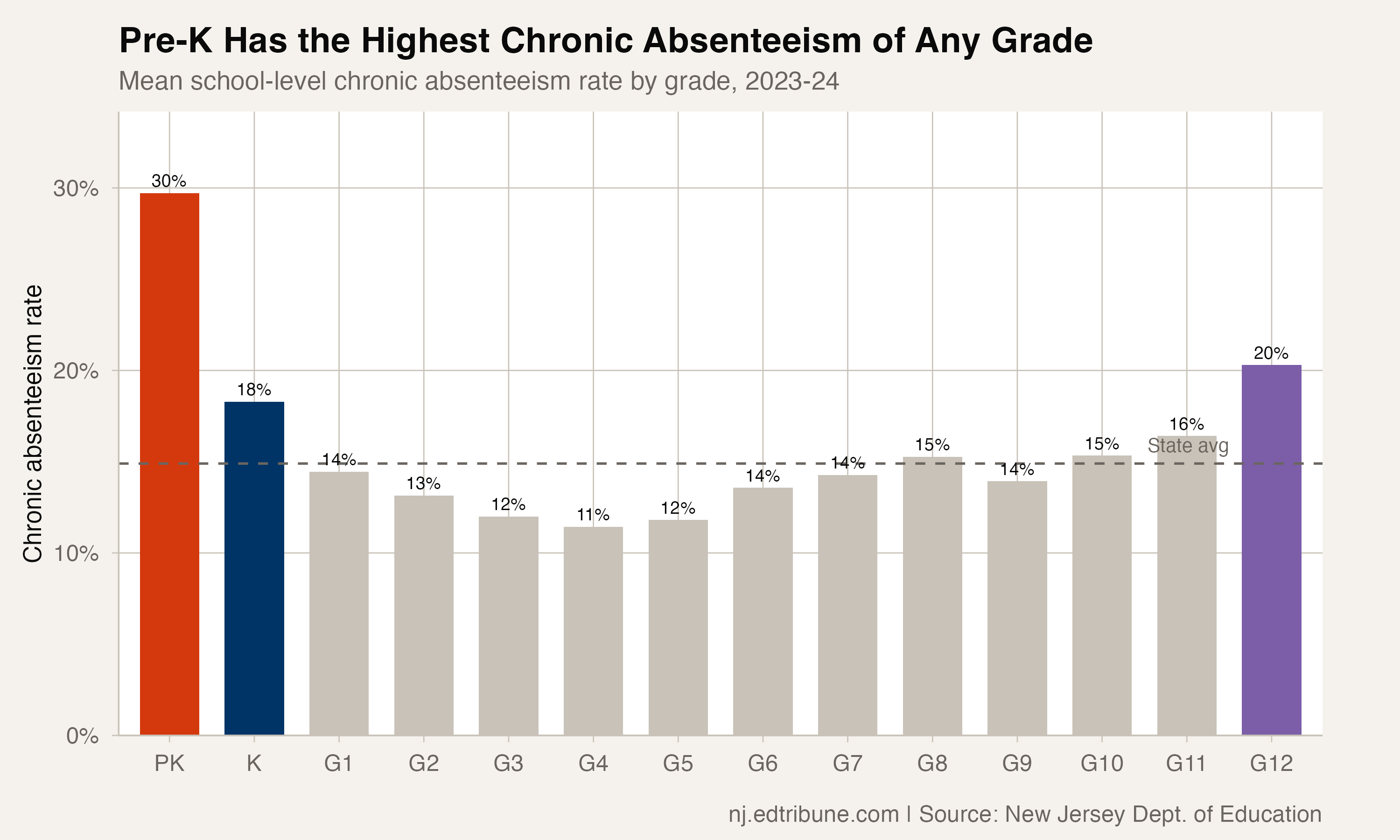
Pre-K's chronic rate is double the statewide average of 14.9%. It is the highest of any grade level, and has been every year the state has tracked it.
The youngest students, the worst attendance
The grade-by-grade picture in 2023-24 tells a clear story. Pre-K sits alone at the top at 29.7%, followed by 12th grade at 20.3% and kindergarten at 18.3%. Fourth grade has the lowest rate at 11.4%. The distribution forms a rough U-shape, highest at the bookends and lowest in the elementary middle.
What separates the two ends of the U is that 12th-grade absenteeism has a name, senioritis, and a cultural acceptance that pre-K absenteeism does not. A 12th grader who skips school is making a choice. A four-year-old who misses school is subject to decisions made by adults: parents weighing whether a sniffle warrants a day home, whether the commute is manageable, whether preschool feels mandatory the way third grade does.
The state recognizes this distinction. New Jersey's Go-Learn-Grow Toolkit, developed with the federal Regional Educational Laboratory Mid-Atlantic, provides districts and early childhood providers with specific strategies to improve attendance among the youngest learners. But the toolkit's existence has not closed the gap.
Kindergarten is the deeper worry
Pre-K's recovery, measured purely by the numbers, has actually been substantial. Of the 13.7 percentage point spike from 2019 to the 2022 peak, pre-K has recovered 88%, returning to within 1.6 points of where it started. That is a better recovery rate than the state average.
Kindergarten tells a different story. Its chronic rate climbed from 12.5% pre-COVID to 24.1% at the peak, an 11.6 point increase. By 2023-24, it had fallen only to 18.3%, a recovery of just 49.8%. Kindergarten remains 5.8 percentage points above its pre-COVID baseline, nearly four times the gap that pre-K still carries.
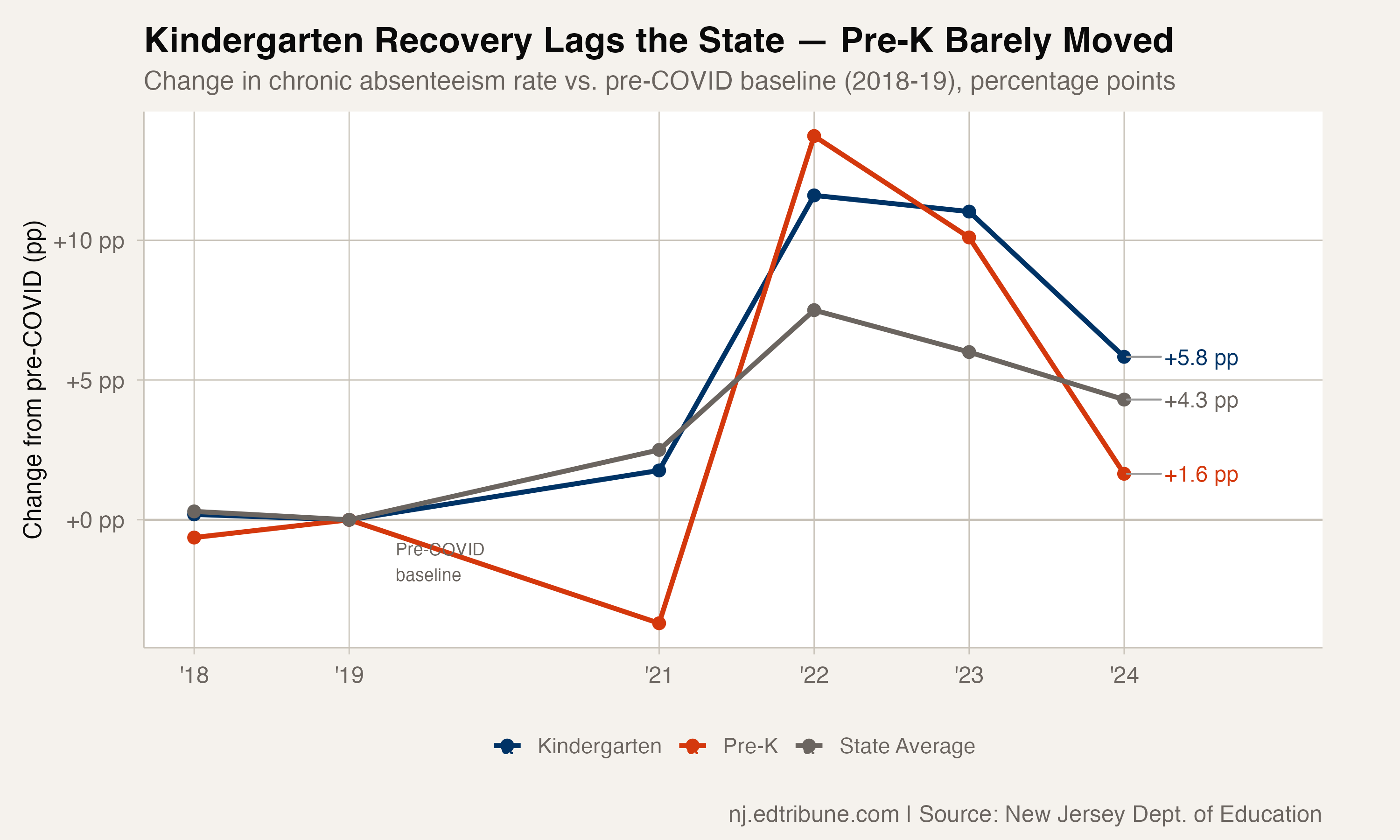
The gap between pre-K and kindergarten chronic rates has actually narrowed since COVID. Before the pandemic, pre-K's rate was 15.6 points higher than kindergarten's. In 2023-24, that gap shrank to 11.4 points, not because pre-K improved dramatically, but because kindergarten got so much worse.
Early childhood towers over every grade band
Grouping grades into bands makes the structural pattern unmistakable. The pre-K and kindergarten band averaged a 24.0% chronic rate in 2023-24. Grades 1 through 3 averaged 13.2%. Grades 4 through 6 averaged 12.3%. Grades 7 and 8 averaged 14.8%. Even grades 9 through 12, including the senioritis effect, averaged 16.5%.
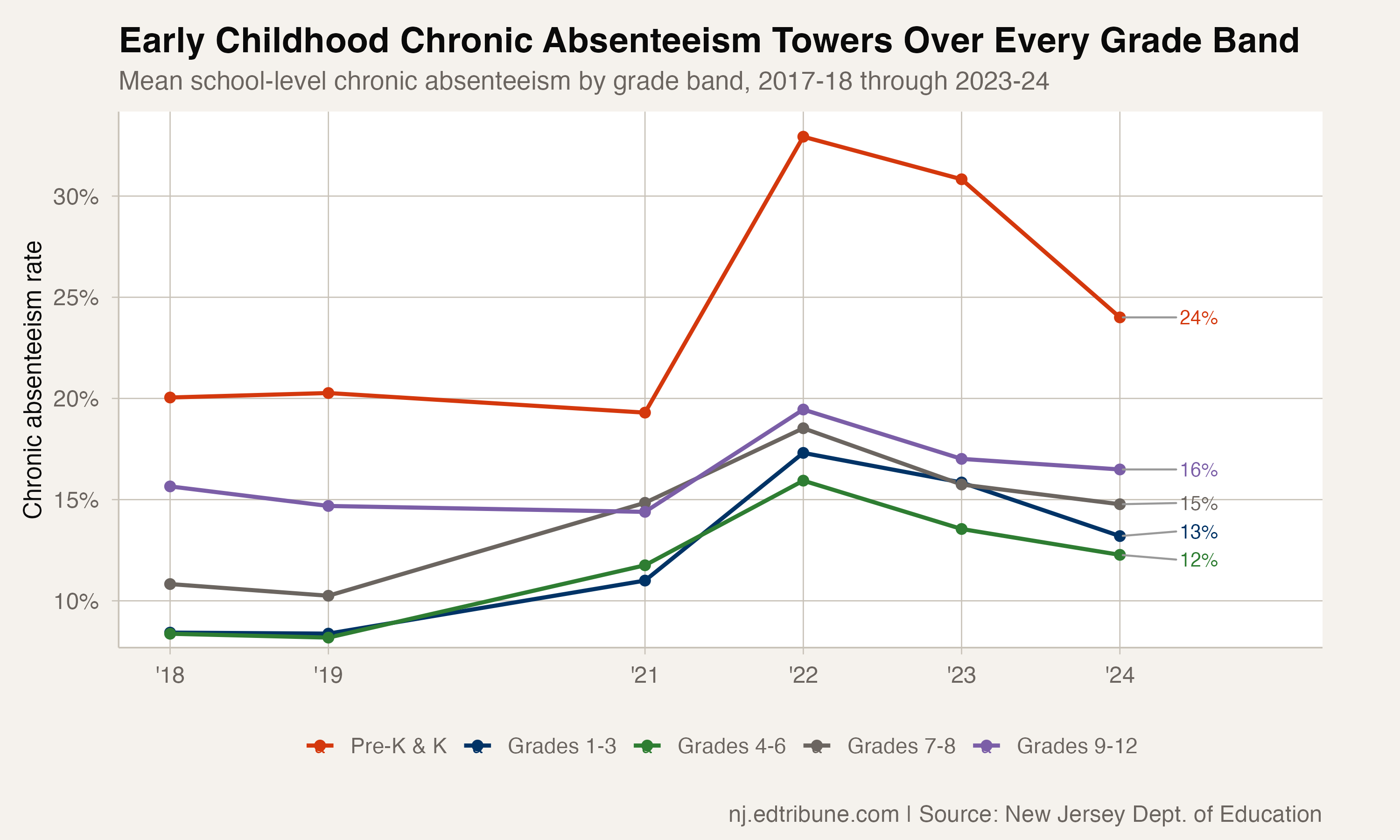
Before COVID, early childhood's chronic rate was 5.6 points above the high school band. By 2023-24, the gap had widened to 7.5 points. COVID hit every age group, but the youngest students bore a disproportionate share and have been slowest to come back.
The scale of the problem inside pre-K programs
In 2023-24, 363 of 822 schools offering pre-K, or 44.2%, had chronic absenteeism rates above 30%. That is down sharply from the pandemic peak, when 70.3% of pre-K programs exceeded 30%, but it remains above the pre-COVID level of 36.8%.
At the severe end, 59 pre-K programs (7.2%) had chronic rates above 50%, meaning more than half their pre-K students were chronically absent. During the 2021-22 peak, 220 programs (26.4%) exceeded that threshold.
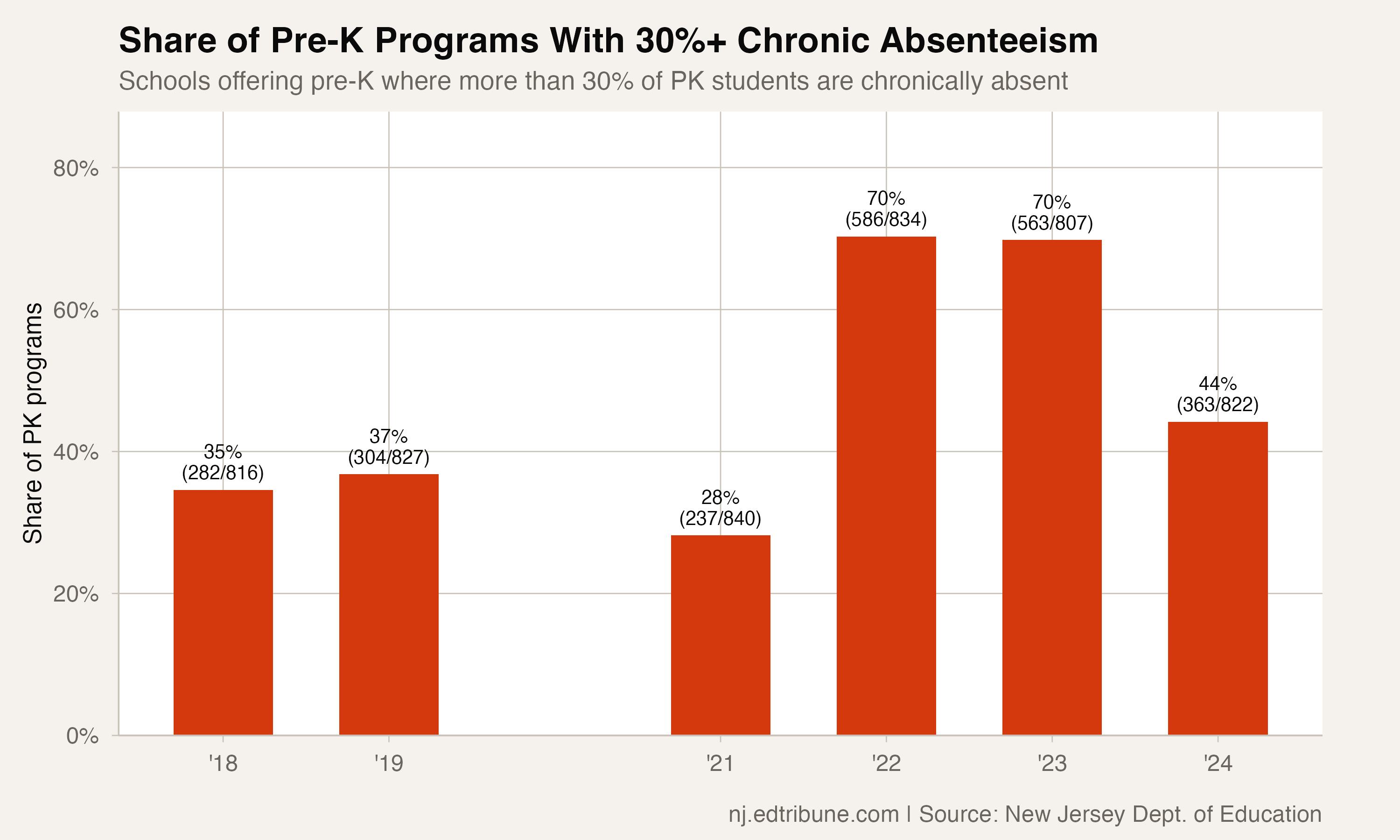
The improvement is real. The share dropped 26 points in a single year, from 69.8% in 2022-23 to 44.2% in 2023-24, after barely budging from the 70.3% pandemic peak the year before. But nearly half of all pre-K programs in the state still have chronic rates above 30%.
Why pre-K is structurally different
Pre-K chronic absenteeism was not created by the pandemic. The rate was 27.4% in 2017-18 and 28.1% in 2018-19, already more than 2.5 times the statewide average in those years. COVID made it worse, but the baseline was already elevated.
Several structural factors explain why pre-K sits apart from every other grade:
Compulsory attendance does not apply. New Jersey's compulsory school age begins at six. Pre-K is voluntary, and parents face no legal consequence for keeping a child home. The attendance accountability structures that apply to older students, including review teams, action plans, and court referrals, carry less weight for families who understand their child is not required to be there.
Health thresholds are different. Young children get sick more often and are subject to stricter exclusion policies. A runny nose that an eighth grader would bring to school might keep a four-year-old home for days. Childcare logistics compound the problem: a sick pre-K student often means a parent home from work, a calculation that does not apply to a self-sufficient teenager.
Transportation is not guaranteed. While New Jersey requires busing for K-8 students living more than two miles from school, pre-K transportation varies by district. Families without reliable transportation face a barrier that disappears once a child enters kindergarten.
The program is still expanding. New Jersey added 20,000 new preschool seats since 2018, extending free pre-K to communities that had never had it. New programs may attract families who are less familiar with attendance expectations, or who enrolled precisely because the program was free and local, not because they view daily attendance as essential.
The state's early childhood attendance advisory asks providers with excessive absenteeism to create action plans and attempt contact with families after three consecutive days of unexplained absence. But "excessive" is not defined uniformly, and enforcement is softer than it is in the compulsory grades.
The universal pre-K paradox
New Jersey is investing heavily in making preschool available to every family that wants it. The evidence that high-quality pre-K improves outcomes is strong, and the state's program has earned national recognition. But a pre-K seat that goes unused 20 or 30 days a year delivers a fraction of its intended benefit.
The 29.7% chronic rate means the state is building a system that roughly a third of enrolled families are not fully using. That is not a pandemic problem. It was true before COVID, it was dramatically worse during COVID, and it has largely returned to its pre-pandemic baseline, which was already the worst of any grade level by a wide margin.
Kindergarten, where attendance is also not compulsory but where expectations are stronger and routines more established, sits at 18.3%, still well above its pre-COVID 12.5% and recovering at half the rate of the state overall. The pipeline from pre-K to kindergarten carries its attendance habits with it.
The 822 schools offering pre-K in 2023-24 served a program that the state considers central to equity and academic readiness. The chronic absenteeism data suggests that for close to one in three families, the commitment to daily attendance has not yet matched the commitment to enrollment.
Detailed code that reproduces the analysis and figures in this article is available exclusively to EdTribune subscribers.
Discussion
Sign in to join the discussion.
Loading comments...