In this series: The NJEdTribune examines New Jersey's latest enrollment decline, the districts defying it, and the demographic shifts underneath the statewide total.
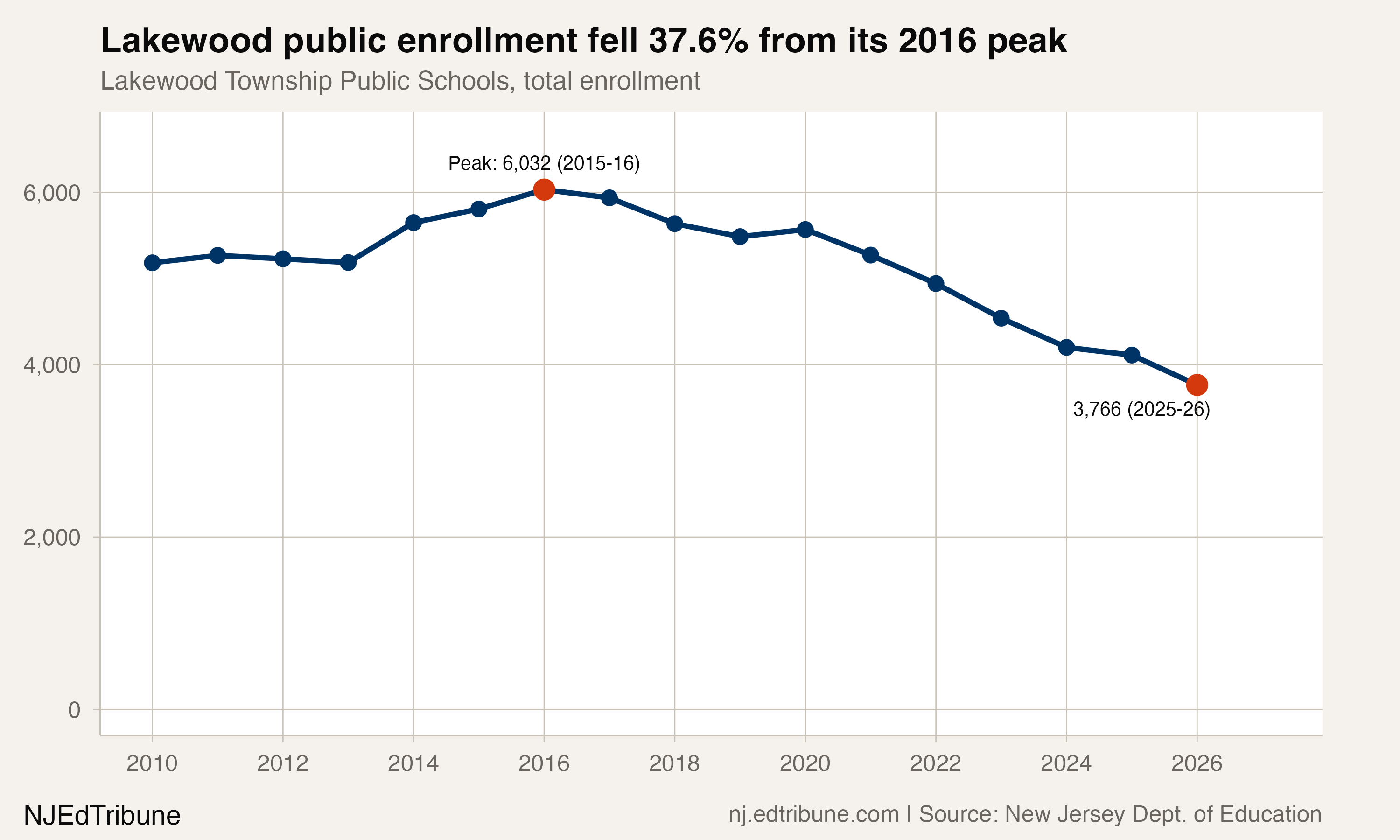
In Ocean County, the township of Lakewood is one of the fastest-growing municipalities in New Jersey. The state's public-school enrollment data shows the opposite trend inside the same boundaries: Lakewood Township↗ET public schools enrolled 3,766 students in 2025-26, down from 6,032 a decade earlier. The district has lost 37.6% of its students from its 2015-16 peak, the steepest such decline of any New Jersey district with 1,000 or more students. In nine of the last ten years, the district has finished smaller than it started.
Four months before this year's enrollment count was published, the state moved to take the district over. On January 15, 2026, the New Jersey Department of Education filed an Order to Show Cause seeking direct control of Lakewood Township School District, citing what Education Commissioner Kevin Dehmer called the need to "course correct" more than a decade of fiscal and operational concerns. The new enrollment number, an 8.4% single-year drop, lands in the middle of that fight.
A decade of losses, accelerating
Lakewood peaked at 6,032 students in 2015-16. Since then, the district has shrunk in every year except one, when enrollment edged up by 83 students during the first COVID school year. Every other year between 2016-17 and 2025-26 finished smaller than the year before, and the losses have grown deeper in the second half of that decade.
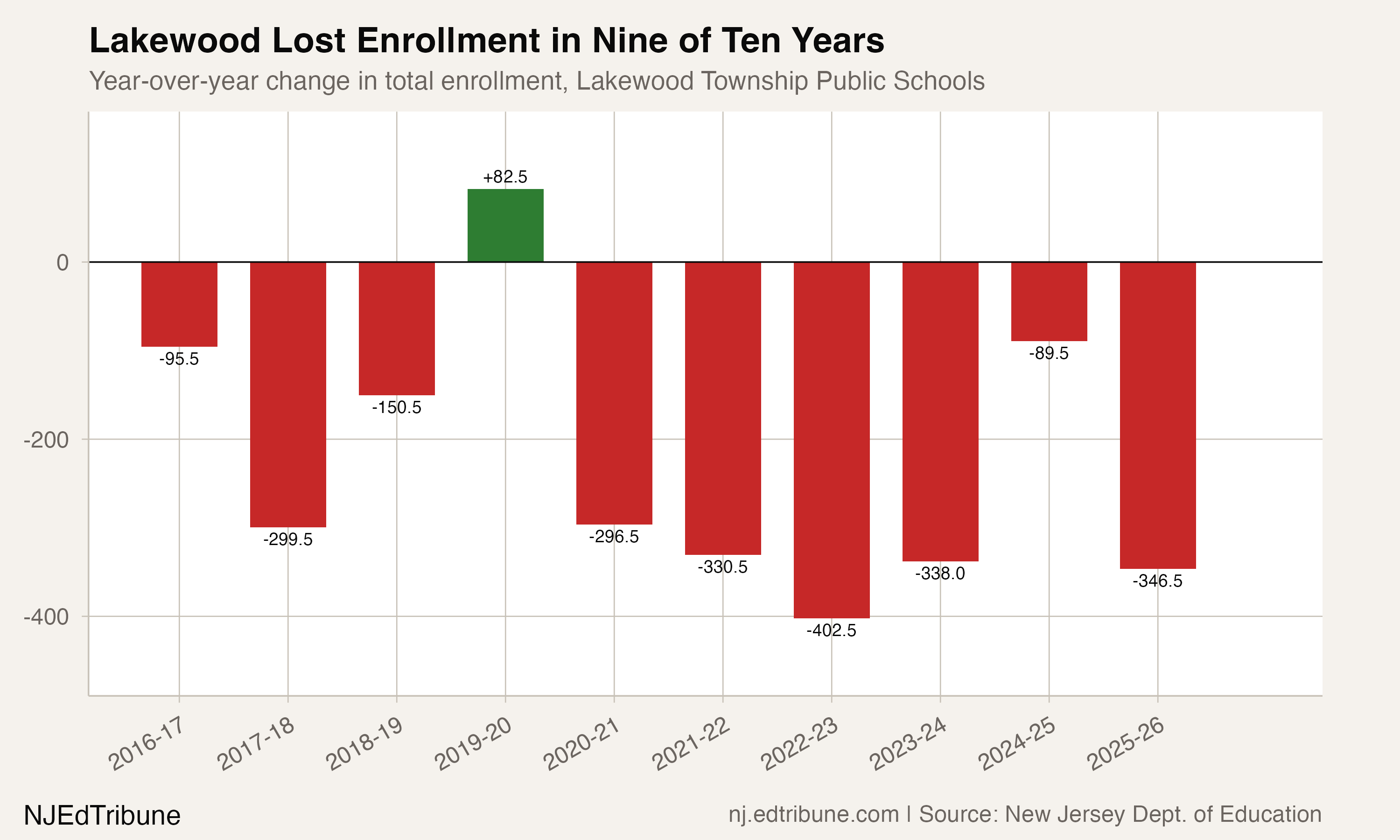
The 2022-23 reading lost 403 students. The 2023-24 reading lost 338. The 2024-25 reading paused, with just 90 students leaving. Then 2025-26 brought another 346-student loss, an 8.4% drop in a single year. New Jersey as a whole lost 1.7% of its public-school enrollment between 2024-25 and 2025-26, the steepest statewide drop on record. Lakewood lost five times that share in the same window.
Compared to its Ocean County neighbors, Lakewood is in a category of its own. Seaside Heights↗ET, a small shore district, has lost 32.1% over the same decade. Jackson Township↗ET, a much larger suburban district, has lost 20.6%. Most other Ocean County districts are clustered between -5% and -15%. Lakewood sits roughly 17 percentage points below the next-deepest local decline among districts of its size.
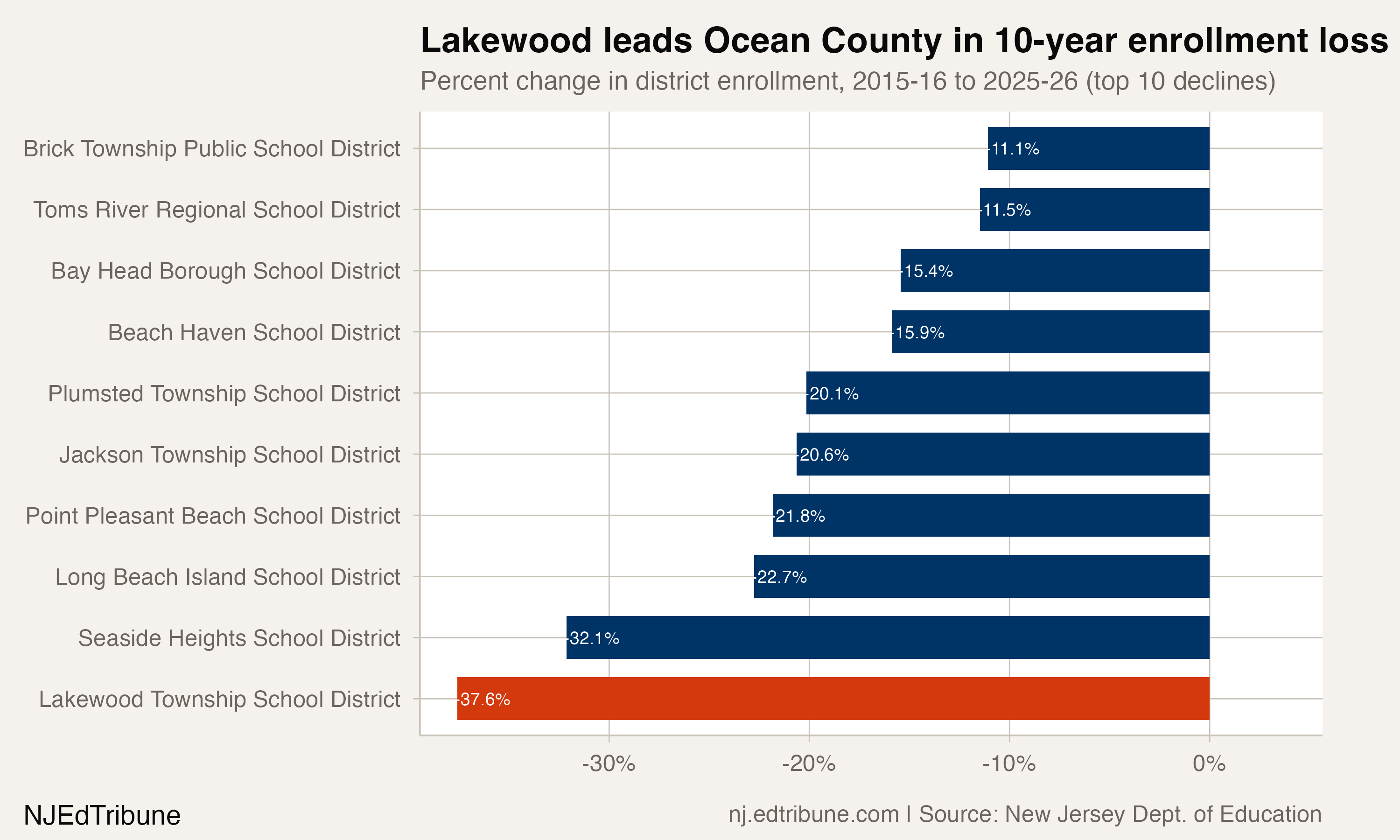
Statewide, Lakewood ranks first among 321 New Jersey districts with at least 1,000 students for percentage decline from 2015-16 to 2025-26. The next-closest is Kittatinny Regional↗ET in Sussex County, at -34.6%.
Two Lakewoods, one budget
Lakewood Township's resident population, estimated at 141,985 in 2024, makes it one of the four largest municipalities in New Jersey. Most of the township's school-age children do not attend its public schools. According to multiple state and local reports surrounding the takeover, more than 50,000 children in Lakewood attend private religious schools, mostly yeshivas serving the township's Orthodox Jewish community. By that count, the 3,766 public-school students represent roughly seven percent of the township's school-age population. The other ninety-some percent are educated outside the public system, in institutions Lakewood's school board does not run.
That ratio shapes everything about the district's finances. Under New Jersey law, public school districts are obligated to provide certain services to resident nonpublic students, most prominently transportation and federally mandated special education services. The cost of those obligations does not scale with the public-school headcount. It scales with the nonpublic-school headcount, which in Lakewood is more than thirteen times larger.
The numbers in the district's most recent budget filings reflect that asymmetry. The district expects to spend more than $48 million on student transportation in 2025-26 while receiving roughly $17.9 million in state transportation aid. Court filings cited in the takeover proceedings indicate that transportation and special education together consume nearly half of Lakewood's operating budget. For most New Jersey districts, those two line items run closer to 10% of expenditures combined, a figure attorneys for Lakewood have repeatedly highlighted in defending the district's spending.
To keep the books closed, Lakewood has run on state advances for years. According to the district's March 2026 response to the takeover filing, New Jersey has provided more than $330 million in loans to the district over the past 12 years, with another $40 million projected shortfall in the current year.
The students who are still in the district
Inside that financial picture, the demographic composition of Lakewood's public-school enrollment has converged on a single group. In 2009-10, 66.5% of Lakewood public students were Hispanic, 25.2% were Black, and 7.8% were white. In 2025-26, 85.4% are Hispanic, 6.1% are Black, and 6.1% are white.
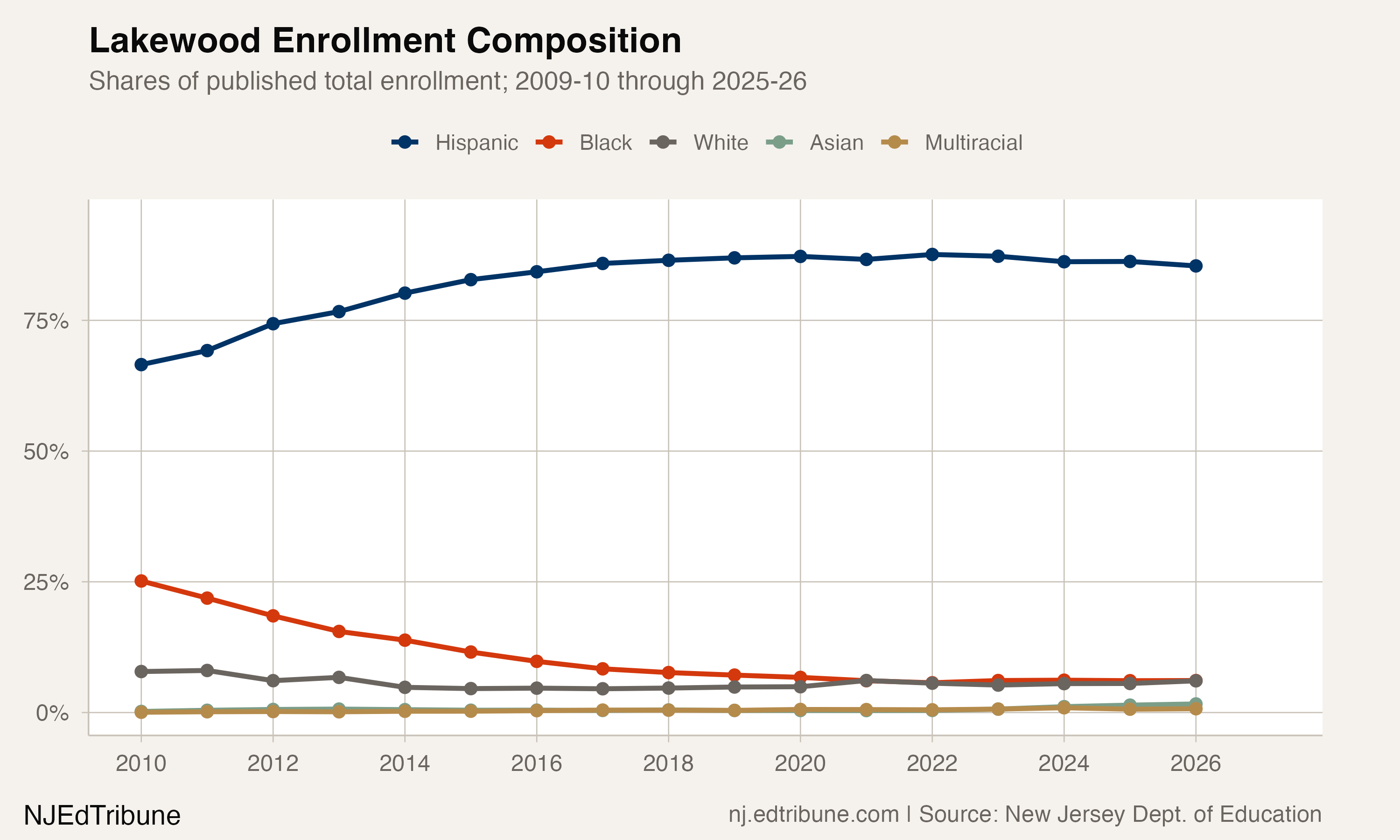
The shift is not the product of new Hispanic enrollment. The Hispanic headcount in Lakewood public schools has actually fallen, from 5,084 at the 2015-16 peak to 3,216 in 2025-26, a loss of 1,868 students. What changed is the denominator. As total enrollment dropped, other groups shrank faster. Black enrollment in the district fell from 1,304 in 2009-10 to 230 in 2025-26, a loss of more than 1,000 students. The Orthodox Jewish families who make up most of the township's growth do not show up in the district's white-student count to begin with, because their children attend yeshivas.
The students who remain are also, increasingly, English learners. The share of Lakewood public students classified as Limited English Proficient rose from 14.1% in 2009-10 to 44.9% in 2025-26. Nearly nine in ten students qualify for free or reduced-price lunch. The students inside Lakewood's public school buildings today are, on the whole, lower-income and more linguistically diverse than the students who were in those buildings a decade ago, even as the buildings themselves serve a smaller share of the township.
What the takeover fight is actually about
The state's January filing argues that Lakewood's board has failed, over more than 15 years of oversight, to address "pervasive, endemic educational and operational failures." District attorneys responded with a 189-page filing in March, arguing that the district's performance on the state's own quality metric remains above the threshold that would justify a takeover and that the structural fiscal mismatch is a state-funding-formula problem, not a governance problem.
That argument echoes a September 2025 appellate ruling that denied Lakewood parents' constitutional challenge to the School Funding Reform Act. The state's funding formula calculates aid on the number of public-school students enrolled, not on the number of resident students the district must serve in some capacity. Local officials, in a joint statement at the time of the takeover filing, said they would welcome a sustainable solution to the structural problem, while attorney Paul Tractenberg, who has spent decades litigating New Jersey school finance, asked: "Why would anyone expect that a generic statewide school funding formula would work for a unique district?"
The enrollment number released this month tightens that question. The state's first published count of Lakewood under takeover proceedings shows a district that is smaller than at any point in recent memory, in a township whose total school-age population is among the fastest-growing in the state. Whichever entity ends up running the district, the same arithmetic will sit on its desk on day one: a public-school headcount of 3,766, a nonpublic-school obligation more than ten times that size, and a funding formula written for a different kind of district.
A 4,112-student district was already an outlier. A 3,766-student district, supported by more than $330 million in cumulative state advances and another $40 million shortfall forecast for this year, is on track to make Lakewood among the lowest-enrollment, highest-per-pupil-cost public districts in New Jersey. The district's response to the takeover filing documents those financial figures. The next number worth watching is not the takeover ruling. It is whether the 2026-27 kindergarten cohort in Lakewood's public schools is larger or smaller than the 264 children currently in kindergarten today.
Detailed code that reproduces the analysis and figures in this article is available exclusively to EdTribune subscribers.
Discussion
Sign in to join the discussion.
Loading comments...