Murat Yazici has spent his career on the business side of New Jersey public schools. Since January, he has run that side of Clinton Township School District↗ET, the Hunterdon County district that educates students from preschool through eighth grade in four schools.
"I’ve spent my career in public school finance and administration, and I genuinely care about doing right by both the students and the taxpayers," Yazici wrote in response to questions from The NJEdTribune. "What drew me to Clinton Township was the opportunity to serve a community that takes pride in its schools."
He described the job in plain terms. "My job is to make sure every dollar is accounted for and goes directly toward supporting our classrooms, teachers, and buildings," he wrote.
The district's leadership page says Yazici came to Clinton Township after seven years as assistant school business administrator for the South Plainfield Board of Education. He oversees budget development, facility management and long-range financial planning. He holds a bachelor's degree in labor economics from Uludag University in Bursa, Türkiye, and an MBA with a concentration in finance from Quinnipiac University. The state's 2025-26 user-friendly budget for the district lists Gretchen Dempsey as business administrator; the 2026-27 edition lists Yazici. He works alongside Superintendent Melissa Stager.
"A simple math problem"
Asked what families most need to understand, Yazici started with arithmetic. "The biggest challenge we face every year is a simple math problem: our state aid and tax revenues just don’t grow as fast as the actual cost of running a school district," he wrote. He named transportation, utilities, health benefits and out-of-district special education placements as areas of sharp cost increases.
The state's spending records show the cost side of that problem. Clinton Township spent $35,494 per pupil in 2023-24, the most recent year of actual spending in the New Jersey Department of Education's Taxpayers' Guide to Education Spending, up 71.4% from $20,713 in 2014-15. The statewide average rose 52.4% over the same years, to $29,950. Clinton Township spent more per pupil than the state average in all 10 of those years.
Yazici added context for that comparison after reviewing a draft of this article. "For the average per-pupil spending, this number includes everything, not just instruction/classroom costs, since Clinton Township is a semi-rural district with high transportation costs; the number is skewed higher than the state average," he wrote. "For comparison, Hunterdon County's average is $34,345 for the same period."
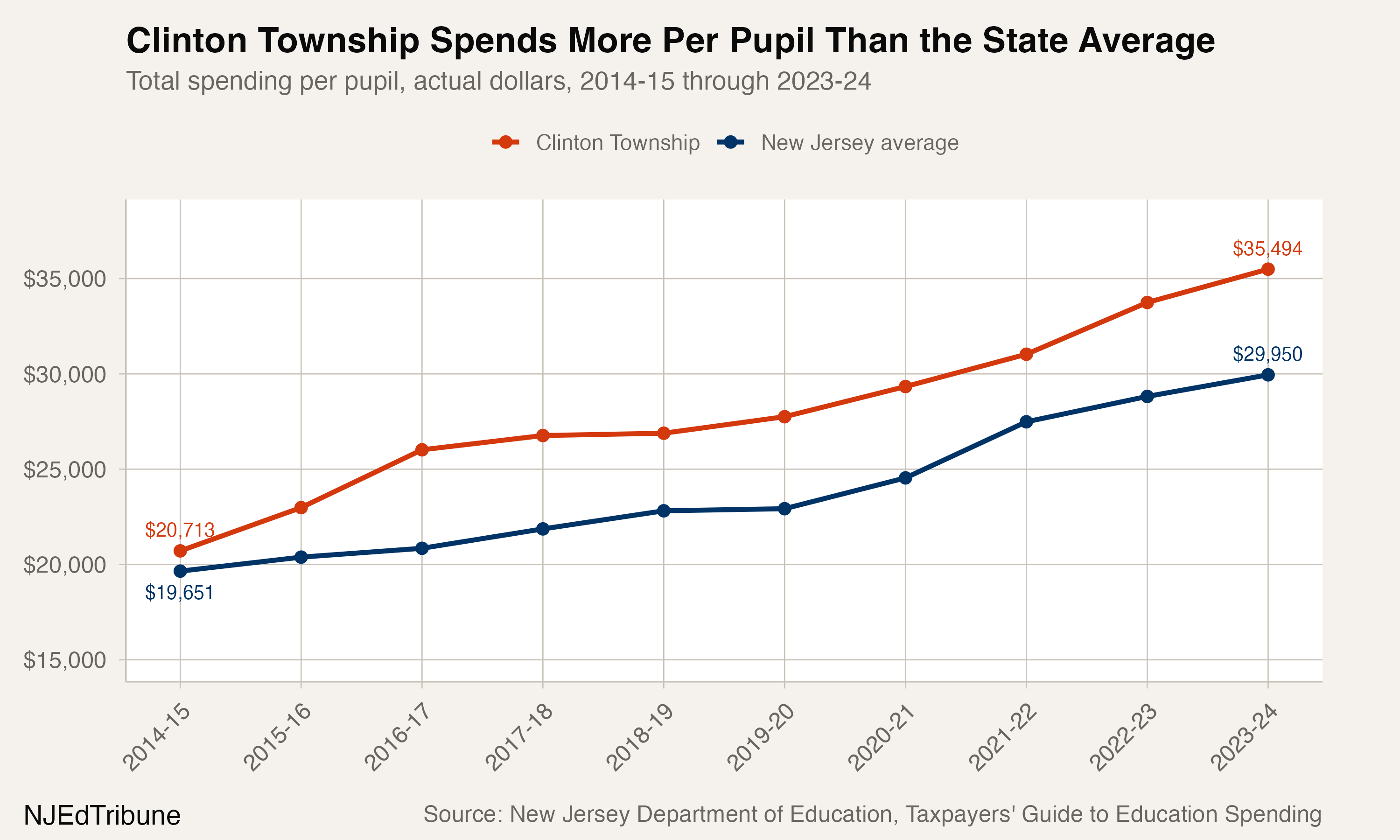
Most of that faster growth came early in the window. From 2018-19 to 2023-24, the district's per-pupil spending rose 32.0%, nearly the same as the statewide average's 31.3%.
A per-pupil figure also moves when the number of pupils does. The guide's pupil count for Clinton Township fell from about 1,458 in 2014-15 to 1,210 in 2023-24. When enrollment falls and costs do not fall with it, spending per pupil rises even if the total budget holds steady. The state's figures do not show how much of the increase came from higher costs and how much came from fewer students.
State aid has moved more slowly. Clinton Township received $2,275,717 in K-12 state aid in 2025-26, up 12.6% from $2,020,647 in 2018-19, according to the state's district aid summaries. Along the way it dipped to $1,842,255 in 2020-21, peaked at $2,340,602 in 2024-25 and then fell by $64,885.
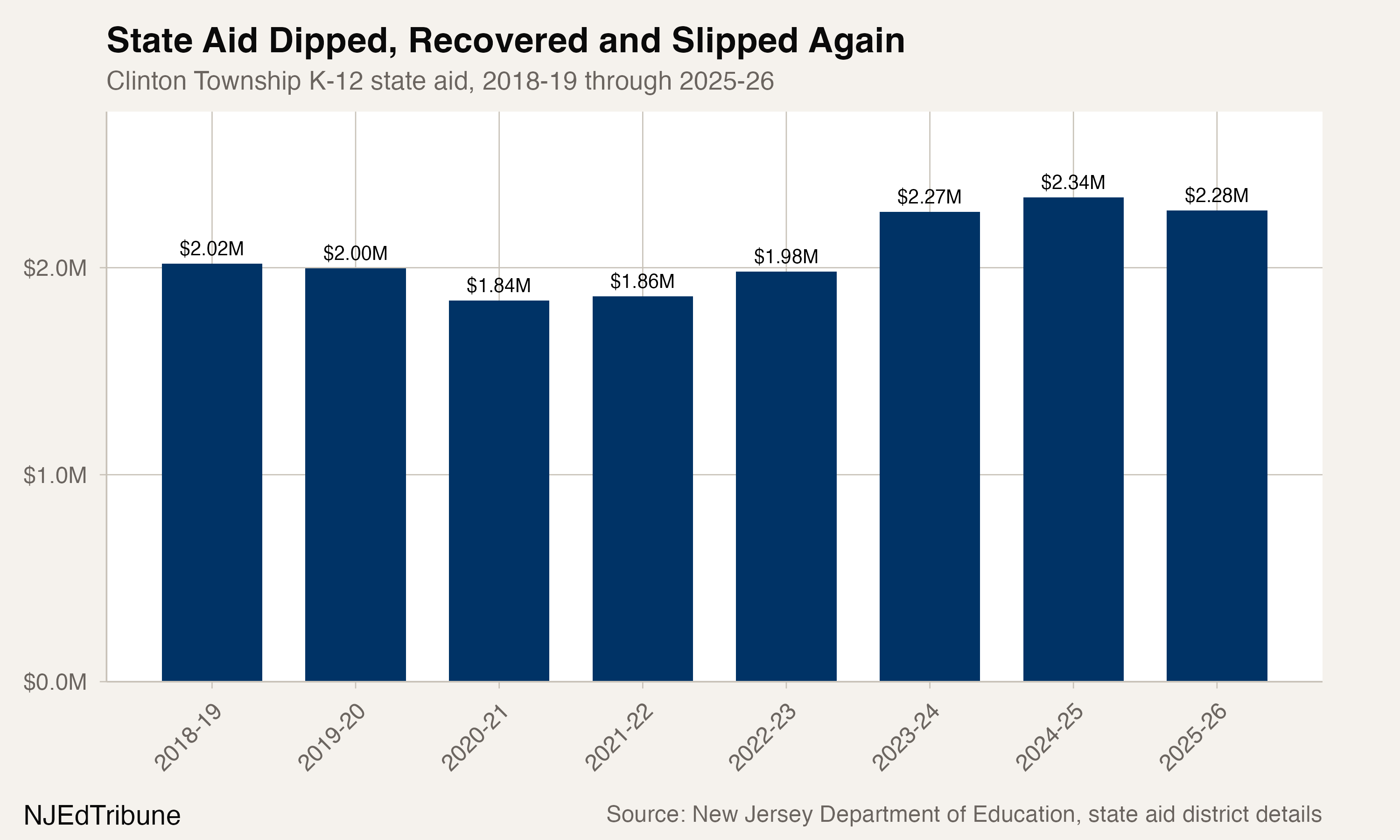
The two series measure different things, one spending per pupil and the other a total dollar amount, so they are not a direct comparison of costs and revenue. Neither covers local property tax revenue.
Pressures he says are specific to the township
Yazici pointed to two. "First, with Exxon phasing out its local operations, the township’s overall commercial ratable base is dropping significantly," he wrote. "When a major commercial taxpayer leaves and the total tax base shrinks, a larger share of the overall property tax burden inevitably shifts onto local homeowners."
"Second, the district carries an existing debt service obligation of roughly $2 million a year through 2034 from the bonds originally issued to build the middle school," he wrote. "Like a mortgage, that is a fixed annual payment we are legally required to make until 2034."
He also wanted families to understand the district's reserve accounts. "Under New Jersey law, money in our capital or maintenance reserves is strictly locked in for specific building and facility needs," he wrote. "We can't legally pull from those funds to offset property taxes or cover day-to-day operating expenses, where the vast majority of our budget is already tied up in contractual salaries and classroom instruction."
Enrollment has turned upward
Yazici arrived as the district's enrollment was climbing again. Clinton Township enrolled 1,451 students in 2014-15. By 2022-23, that had fallen to 1,166, a 19.6% drop, with enrollment declining in seven of those eight years. It has risen in each of the three years since, reaching 1,266 in 2025-26, the most recent school year in the state's published data. That is 100 more students than at the low, an increase of 8.6%. Counts for the current school year will differ once the state publishes 2026-27 data.
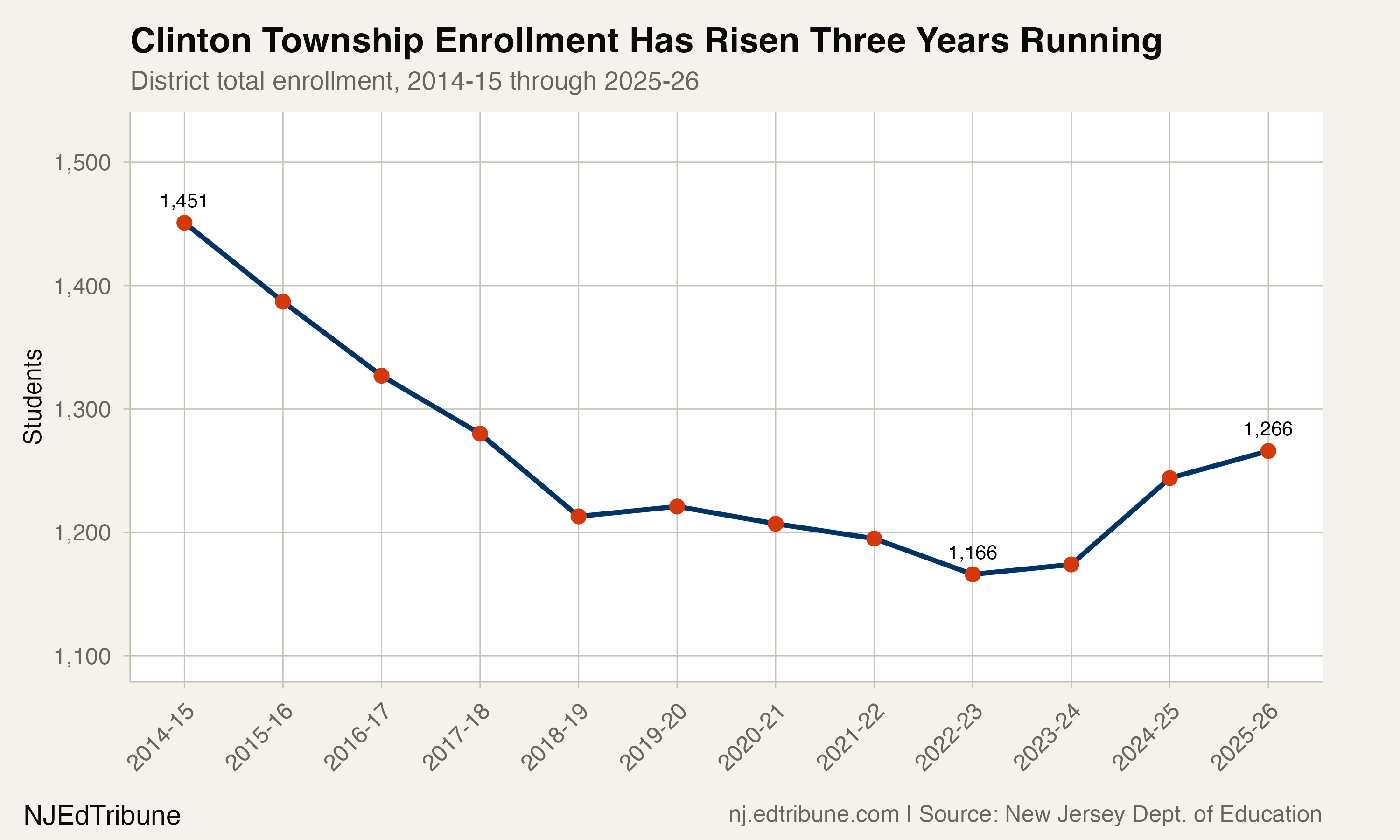
Yazici credits preschool. "The enrollment increases we've seen over the last couple of years are mostly from the full state-funded preschool program," he wrote. The state's enrollment files show the same pattern. Preschool enrollment rose from 31 students in 2022-23 to 114 in 2025-26, accounting for 83 of the 100 added students, and all 114 were counted in full-day preschool. Enrollment in every other grade combined grew by 17 over the same years.
The 2025-26 count remained 12.7% below 2014-15, while statewide enrollment was 0.9% lower across the same years. Its K-8 students were split almost evenly among three schools: 390 at Clinton Township Middle School, 384 at Patrick McGaheran School and 379 at Round Valley School, with 113 at Spruce Run Preschool.
What he wants to keep steady
"My top priorities are maintaining absolute fiscal transparency and ensuring operational continuity," Yazici wrote. "As we navigate difficult challenges, including legal matters and ongoing litigation, my priority, working closely with the Board of Education and the Superintendent, is to address them responsibly and safeguard district resources to minimize their impact on our classrooms, students, and families."
He said his own perspective on the work isn't only professional. "At the end of the day, though, I’m a public school parent too," he wrote. "When I look at a budget or a facility project, I’m not just looking at numbers on a spreadsheet; I’m looking at what it takes to keep our schools safe, well-resourced, and running the way families expect them to."
Enrollment figures come from the New Jersey Department of Education enrollment files covering 2014-15 through 2025-26. Spending figures come from the department's Taxpayers' Guide to Education Spending, and state aid figures from its state aid district summaries.
Detailed code that reproduces the analysis and figures in this article is available exclusively to EdTribune subscribers.
Discussion
Sign in to join the discussion.
Loading comments...